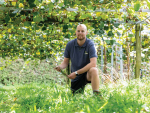
Rabobank Launches HortPathways for Emerging Hort Leaders
Twenty-eight emerging leaders from across the horticulture sector spent two days last month learning valuable skills and connecting with industry experts.




 increase font size
 Rabobank Research’s Nick Fereday says plantbased meat sales have hit a wall in the US.
The plant-based meat product sector in the US is in a crisis, according to Rabobank's US-based executive director Rabobank Research, Nick Fereday.
Sales have "hit a wall" and Fereday blames this on price and taste - two of the main factors that drive consumer purchasing habits.
Speaking to a group of leading farmers from 12 countries in Hamilton last week, Fereday says plant-based meat and milk have been at the forefront of farmers' minds since 2019.
Plant-based meat and dairy sales were growing, although they started from a small base. While plant-based dairy sales seem to be holding up in the US, plant-based meat sales have tanked.
Fereday says it comes down to taste and price.
"At the end of the day, they are asking consumers to pay more for a product that isn't as tasty as the product they are trying to replace," he says. "Usually, new products are sold at a discount, but they did the opposite for plant-based meat."
A recent survey by Rabobank NZ and KiwiHarvest shows that vegetarian numbers saw little change while vegans significantly decreased back to 2021 numbers.
Fereday notes that the US plant-based market had received a boost at the start of the Covid-19 pandemic when consumers were forced to seek out meat alternatives because of supply chain issues. The sector was boosted by double digits at the start of the pandemic. But the sector has failed to recover since the pandemic.
Fereday says major meat companies who had invested in plant-based meat companies were pulling back.
Meat titan JBS abandoned its plant-based business in the US just two years after entering the alternative meat market in that country. Canada's Maple Leaf Foods reduced its plant-based investment, citing slower sales.
He believes long term there is potential for plant-based meat, not as an alternative to meat but as a vegetarian option.
While plant-based meat is overpriced and under delivering in the US, plant-based milk consumption is growing. Fereday says it doesn't taste as good as milk but is attractive to the lactose intolerant who make up a sizeable part of the US population.
Best of the Best
Twenty-eight farmers from five continents and 12 different countries are spending 10 days in New Zealand taking part in the latest Rabobank Global Farmers Master Class (GFMC).
The bank describes it as a state-of-the-art agri learning programme established in 2012 to bring together leading farmers from around the world to address global food security.
The 2023 Rabobank GFMC kicked off in Hamilton last week and will finish in Queenstown on December 6.
The master class programme will feature presentations from top agricultural thinkers and business experts, interactive workshops and case studies, as well as visits to a range of flagship agribusiness operations in both the North and South Islands.
Twenty-eight emerging leaders from across the horticulture sector spent two days last month learning valuable skills and connecting with industry experts.

A 'tsunami' of milk from key exporting countries is winding down and this may be good news for New Zealand dairy farmers.
Chinese beef trade quotas and a looming suspension of Brazilian beef imports into the European Union are expected to reshape global beef trade flows over the remainder of 2026, with implications for New Zealand exporters, according to Rabobank's Q3 Global Beef Quarterly report.
New Zealand consumers are paying more for beef mince than ever before, with the average retail price now sitting above $24 per kilogram, according to Rabobank.
West Otago dairy farmer Luke Kane has been awarded the 2026 Rabobank Dr John Morris Business Development Prize.


Federated Farmers has welcomed new rural policies released by ACT, saying they align closely with its own election priorities.

Rural Contractors NZ says proposed changes to land transport rules for agricultural vehicles are a welcome response by the Government to out of date regulations which have seen members hit with huge fines.
Alliance is calling for final applications for its 2027 Graduate Programme, with applications closing on Sunday 25 October.
Decades piloting planes has ensured vet and farmer David Hayes is focused on safety. So, after a serious accident while welding on farm, he is sharing his experience so others can learn from it.
Canterbury milk processor, Synlait Milk has confirmed Leon Fung as its chief executive officer.
OPINION: Making it easier to collect rainwater and use it to grow crops and livestock is a no brainer.




OPINION: The same mainstream media muppets that brought you Jacindamania in 2017 have been flat out pimping for the Opportunities…
OPINION: Your old mate reckons the atrocious way farmers in the UK are treated by their lords and masters in…




