India FTA Unites NZ First, Greens
National’s much-touted free trade deal with India featured in the Rural Issues Debate at Mystery Creek, Hamilton on Wednesday night.




 increase font size
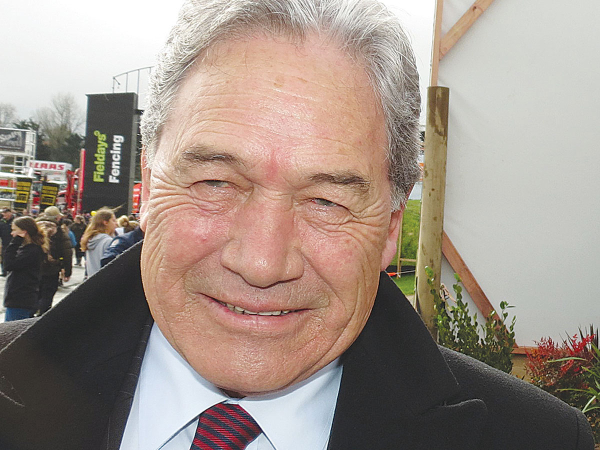 Deputy Prime Minister and Foreign Minister Winston Peters.
Deputy Prime Minister Winston Peters often describes NZ as a small and isolated nation situated 'just north of the penguins' but says in terms of global affairs, NZ and other small nations should be judged on the quality of their arguments and not the size of their military.
He has talked about the shift from rules-based trade to where the size and power of a nation override the rules-based system. Over many years, NZ has been recognised as a nation that supports, and needs for its survival, a rules-based trading system.
In recent years, NZ played a pivotal role in the establishment of the Comprehensive and Progressive Agreement for Trans-Pacific Partnership (CPTPP) - a trade deal between 12 Asia Pacific economies including Australia, Canada, Japan, Malaysia, NZ, Singapore, and Vietnam.
Peters says while negotiating the arrangement, NZ insisted on and got the significant words "comprehensive and progressive" to be included in the title of the agreement to give it more weight.
Reflecting on the evolution of the NZ economy over the years, Peters expresses disappointment. He says that countries such as Ireland and Australia have got the jump on us over the years. He says in 1981 when in Ireland, he saw a dramatic change in its development.
"In many ways, we have left ourselves behind. If we had been as clever as Ireland was then, we would be in a much better position than we are today," he told Rural News.
As Foreign Minister, Peters seems to spend as much time in his office. When Rural News pointed out his age - 80 - Peters laughed and pointed out he learned at an early age how to burn the candle at both ends.
"I was brought up on a farm and I had to milk the cows before I went to school and when I got home in the evening, I had to milk them before I did my homework, and that hard work in my early life has helped me deal with the hard work and long hours that I do as a politician," he says.
Peters also muses that older people should be encouraged to stay working, because they know what they are doing and don't mind working long hours.
"For us being five minutes early for work is being on time and being on time is late," he says.
National’s much-touted free trade deal with India featured in the Rural Issues Debate at Mystery Creek, Hamilton on Wednesday night.

OPINION: The United States wine market has changed forever, and companies cannot use same old playbook, said Erin Kirschenmann at the New Zealand Wine 2026 Wine Business Forum in August.
It was billed as a chance for all the political parties to woo the rural vote, but question marks hang over just how effective this was.
Red meat farmers are welcoming Labour’s plan to review the Emissions Trading Scheme and not to campaign on pricing agricultural emissions.
For the first time in a quarter of a century, Federated Farmers has something positive to say about the Labour Party’s climate change policy leading into a general election.


Federated Farmers has welcomed new rural policies released by ACT, saying they align closely with its own election priorities.
Rural Contractors NZ says proposed changes to land transport rules for agricultural vehicles are a welcome response by the Government to out of date regulations which have seen members hit with huge fines.
Alliance is calling for final applications for its 2027 Graduate Programme, with applications closing on Sunday 25 October.
Decades piloting planes has ensured vet and farmer David Hayes is focused on safety. So, after a serious accident while welding on farm, he is sharing his experience so others can learn from it.
Canterbury milk processor, Synlait Milk has confirmed Leon Fung as its chief executive officer.
OPINION: Making it easier to collect rainwater and use it to grow crops and livestock is a no brainer.



OPINION: The same mainstream media muppets that brought you Jacindamania in 2017 have been flat out pimping for the Opportunities…
OPINION: Your old mate reckons the atrocious way farmers in the UK are treated by their lords and masters in…




