
Final call for Alliance’s 2027 Graduate Programme
Alliance is calling for final applications for its 2027 Graduate Programme, with applications closing on Sunday 25 October.




 increase font size
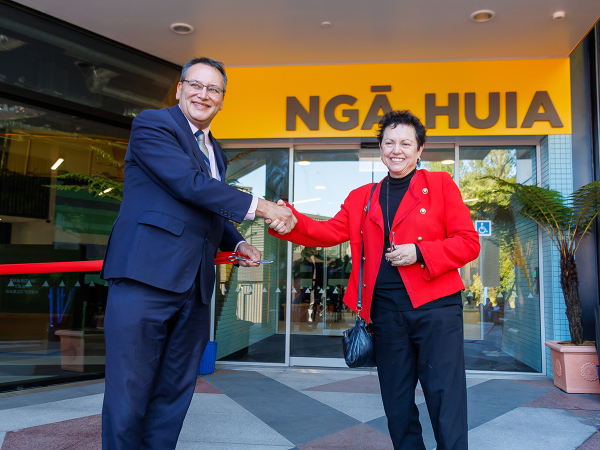 Minister for Universities Shane Reti and Massey University Vice Chancellor Professor Jan Thomas.
Minister for Universities, Shane Reti, has opened the final new build in a ten plus year project to upgrade the veterinary facilities at Massey University.
Ngā Huia is a new $70 million veterinary research and teaching facility on Massey’s Manawatū campus, with state of the art laboratories for specialised researchers in areas such as Pathobiology and Infectious Diseases, the Animal Welfare Science and Bioethics Centre, and production, working and native animal health.
The building includes academic and postgraduate student offices, as well as student collaboration and study spaces.
Ngā Huia was blessed by Rangitāne o Manawatū which led a dawn karakia, waiata, and walk-through of the new building, before the official ribbon cutting event.
The opening was attended by over 150 invited guests, key staff from Tāwharau Ora School of Veterinary Science and the College of Sciences and those involved in the build project.
Pro Vice-Chancellor College of Sciences Professor Ray Geor, described the Ngā Huia opening as a significant milestone in the School of Veterinary Science’s 64 year history.
“Ngā Huia will strengthen our ability to lead and support the nation to battle disease outbreaks, deal with pandemics and care for the animals in Aotearoa New Zealand," says Geor.
"As an alumnus myself, I am very proud that Massey is reinforcing its highly regarded reputation for excellence in veterinary science and as an applied university at the heart of Aotearoa New Zealand’s economy.”
During the COVID-19 pandemic, Massey’s School of Veterinary Science was called on for assistance responding to the disease outbreak; growth of One Health (a collaborative, multidisciplinary approach that recognises the interconnectedness of the health of humans, animals, and ecosystems); World Health Organization (WHO) expert advice, and to provide expertise to the New Zealand government and globally.
The Ngā Huia opening completes the third phase of the $160 million veterinary facilities upgrade programme, which was first approved by University leadership in 2011 and has been fully funded by Massey.
The upgrades have included Massey’s equine hospital, new Wildbase facilities (native wildlife hospital), veterinary clinic spaces and the Student Learning complex with new pathology, anatomy and clinical skills laboratories. These works also included demolition of the iconic former Vet Tower during 2022.
Vice-Chancellor Professor Jan Thomas praised the Massey project team and companies which provided architectural, engineering, building and construction services for completing the Ngā Huia build on time and within budget.
“This has been a period of significant change, with the almost complete reinvention of Tāwharau Ora. You have helped us to build a world class veterinary school that will deliver what the profession, and indeed our nation needs in the future.”
Tāwharau Ora School of Veterinary Science is the sole provider of veterinary education in New Zealand, and for the past two years has been named the number one veterinary school in Australasia and Asia and ranked 19th in the world in the QS University Rankings. In 2023, Massey increased its intake to 175 students per year.
Head of the School Professor Jon Huxley told the audience that for the past four years, Massey veterinary graduates have ranked in the top six globally, based on employer reputation. The support and input of key industry organisations such as the New Zealand Veterinary Association, the Veterinary Council of New Zealand and the Office of the Chief Veterinary Officer has played a key role in this ongoing success.
“The industry supports our goals and ambitions to be world leading in veterinary science, promoting and supporting the veterinary profession in partnership with us,” Professor Huxley adds.
Alliance is calling for final applications for its 2027 Graduate Programme, with applications closing on Sunday 25 October.

Federated Farmers is backing Feilding High School’s call to keep Agriculture and Horticultural Science as a standalone subject in Year 11.
Vetekina Pau'u is the first Tongan to win the William Gearish Memorial prize and sadly she will also be the last recipient.
Pāmu has welcomed Taranaki student Paige Burston as its newest First Foundation Scholar, supporting her journey towards a career in agriculture and animal science.
Researchers at Massey University are using a special piece of scientific equipment to improve the measurement of greenhouse gas emissions from pasture soils.



Federated Farmers has welcomed new rural policies released by ACT, saying they align closely with its own election priorities.

Rural Contractors NZ says proposed changes to land transport rules for agricultural vehicles are a welcome response by the Government to out of date regulations which have seen members hit with huge fines.
Alliance is calling for final applications for its 2027 Graduate Programme, with applications closing on Sunday 25 October.
Decades piloting planes has ensured vet and farmer David Hayes is focused on safety. So, after a serious accident while welding on farm, he is sharing his experience so others can learn from it.
Canterbury milk processor, Synlait Milk has confirmed Leon Fung as its chief executive officer.
OPINION: Making it easier to collect rainwater and use it to grow crops and livestock is a no brainer.





OPINION: The same mainstream media muppets that brought you Jacindamania in 2017 have been flat out pimping for the Opportunities…
OPINION: Your old mate reckons the atrocious way farmers in the UK are treated by their lords and masters in…




