
NZKGI Responds to Migrant Worker Exploitation Reports
Where any worker in the kiwifruit industry is mistreated, we expect the authorities to take action.




 increase font size
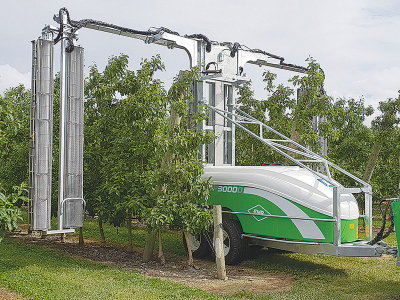 FMR O-Series orchard sprayer.
FMR Group has turned its attention to the orchard industry with its new O-Series.
Ten years ago, FMR launched its V-Series vineyard sprayers that improve canopy penetration and chemical application, and reduce spray drift.
The 2010 release of its R-Series recycling sprayer raised the bar even higher, allowing vineyards to reduce costs further by recycling spray that would otherwise have been lost as spray drift.
Using the technology in this design FMR has now turned its attention to the orchard industry.
Working with Richard and Tristram Hoddy, Vailima Orchards, Tasman district, the company has adapted the same base technology as found in the V-Series to design and build a 3-row sprayer specifically for orchard spraying.
The O-Series uses key technologies common to all FMR sprayers, including a tangential fan system from Weber, Germany, and Arag valves and electronic control equipment from Italy.
Air-blast or air-shear systems have traditionally relied on high pressure/low volume jets to deliver spray, but high levels of off-target drift and potentially uneven application to target surfaces risks low efficiency in such set-ups.
Spray drift increasingly bothers rural operators -- especially growers -- as they are pressured to clean up their acts, chiefly by adopting new technology or techniques.
The Weber tangential fan works differently, producing a full length ‘curtain’ of low velocity, high-volume air which is uniform from top to bottom of a tree. This air curtain emerges from the tangential fan with a turbulent twisting action that creates leaf movement and facilitates canopy penetration and even application to target plant surfaces.
The even air curtain of high volume/low pressure air allows the sprayer to be set up quickly to suit specific canopy styles and to minimise off-target drift.
Operator comfort and safety are notable in all FMR sprayers, so the tangential fan system is quiet — even when run at full speed — so improving operator comfort.
The hydraulically driven fan can be run at speeds easily adjusted to suit conditions.
Meanwhile, the Arag Bravo electronic control system allows full control from the cabin, using a GPS speed sensor on the sprayer to automatically control system pressure and flow to achieve the chosen application rate.
The sprayers’ tanks are made from fibreglass in capacities 2300, 3000 and 4000L.
All units have a fresh water tank for system purging and operator handwashing.
Where any worker in the kiwifruit industry is mistreated, we expect the authorities to take action.

Kiwifruit growers are watchful but remain optimistic as concerns around the potential effects of the El Niño weather pattern this season.
James Blair, an agronomist for AS Wilcox and the Pukekohe regional champion, has won the 2026 Young Grower national title.
Claimed to be the first autonomous robot for New Zealand vegetables growers, the first Kilter AX-1 unit has arrived in the country.
After delivering a strong financial year, rural trader PGG Wrightson says the coming months will depend on customer confidence and weather.



Beef + Lamb New Zealand says the National Party’s agriculture plan provides a strong basis for lifting productivity, supporting rural communities and recognising the sheep and beef sector’s environmental track record.

Wools of New Zealand chief executive John McWhirter says its new direct-to-consumer wool carpet service, Laneve, is the next step in the development of the business.
The New Zealand-India Free Trade Agreement entered into force today, improving market access for New Zealand businesses across a wide range of sectors.
Vetekina Pau'u is the first Tongan to win the William Gearish Memorial prize and sadly she will also be the last recipient.
Things are looking up in the dairy goat sector.
As the India-New Zealand free trade agreement enters into force, New Zealand’s apple industry has reaffirmed its commitment to the long-term development of India’s apple sector.




OPINION: The same mainstream media muppets that brought you Jacindamania in 2017 have been flat out pimping for the Opportunities…
OPINION: Your old mate reckons the atrocious way farmers in the UK are treated by their lords and masters in…




