Cyclone Gabrielle: Hawke's Bay Orchardists Still Recovering
Three and a half years on from when Cyclone Gabrielle hit Hawke's Bay, some orchardists in the region are still receiving counselling to help them deal with the trauma they suffered.




 increase font size
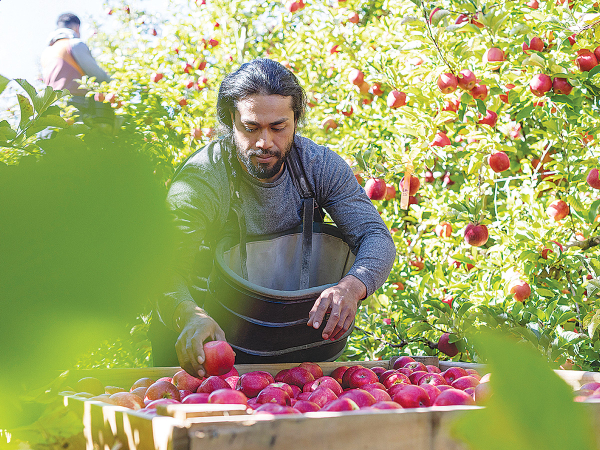 Apples and Pears NZ's early estimate is that Cyclone Gabrielle has impacted this year's crop by around 5 million tray cartons. Photo Credit: Paul Sutherland Photography.
The country's export apple crop has taken a big hit as a result of the damage caused by Cyclone Gabrielle.
Apples and Pears NZ chair Richard Punter says before Cyclone Gabrielle, his organisation had an early estimate of 20.30 million TCE's (tray carton equivalents of apples). However, the latest figure points to the export crop being down to 15.8 million TCEs.
He told Rural News the numbers may still vary in the coming months as reports come in of how apple trees have survived the cyclone. Some trees have either been wiped out by the cyclone or have subsequently died because their roots were waterlogged or covered in silt. Some trees survived this damage, but any fruit that was under the floodwaters had to be written off.
Meanwhile, Punter has welcomed the Government's recently announced near billion dollar package to repair infrastructure saying an important part of getting fruit to market is having good roads and bridges. Talks between government officials are ongoing and another round of talks with growers is scheduled in the next few weeks.
However, Rural News is aware of mounting frustration from growers and orchardists at the time it's taking officials to come up with a viable recovery plan. One person told us they felt like nothing had happened in the two months since the cyclone. Others have complained that the officials have no understanding of what's needed. "They don't seem to comprehend that reinstating a pumpkin patch is vastly different to reinstating an apple orchard," complained one grower.
They went on to say that the bureaucrats can't seem to comprehend that with an apple orchard, the land has to be cleared, new structures erected, new trees ordered and then planted and that it could take ten years before the grower gets a commercial crop.
And there is the cost. It's well known that any income earned in the first six years will simply be used to pay off debt.
Punter says he's aware of the frustrations of growers and says some are seeing what's ahead of them as almost impossible to deal with. He says Finance Minister Grant Robertson recently acknowledged that growers can't be expected to fund all the costs of the recovery.
"What's needed is some very clever financial engineering to make capital available to growers that can be paid off over time," says Punter.
To try and get everyone working off the same page in the recovery, NZ Apples and Pears is preparing a basic leaflet setting out step-by-step the actions, timing and costs involved in reinstating an orchard - a dummies' guide to orchard reinstatement, if you like.
Punter hopes this 101 paper on how best to deal with the recovery of orchards will help speed up the process and lead to outcomes that work for the many growers who are facing hard and uncertain times.
Three and a half years on from when Cyclone Gabrielle hit Hawke's Bay, some orchardists in the region are still receiving counselling to help them deal with the trauma they suffered.

The chief executive of Apples and Pears New Zealand, Danielle Adsett, says fruit quality this year is phenomenal and the sector is hitting crop estimates, which is great for growers.
New Zealand exporters are putting the blowtorch on politicians to get the free trade deal with India over the line.
Nearly three years on from Cyclone Gabrielle, Hawke's Bay apple orchardist Paul Paynter says they are still doing remedial work around their orchards and facing financial challenges.
If there was a silver lining in the tragedy that was Cyclone Gabrielle, for New Zealand Young Grower of the Year, Grace Fulford, it was the tremendous sense of community and seeing first-hand what good leadership looks like.



Federated Farmers has welcomed new rural policies released by ACT, saying they align closely with its own election priorities.

Rural Contractors NZ says proposed changes to land transport rules for agricultural vehicles are a welcome response by the Government to out of date regulations which have seen members hit with huge fines.
Alliance is calling for final applications for its 2027 Graduate Programme, with applications closing on Sunday 25 October.
Decades piloting planes has ensured vet and farmer David Hayes is focused on safety. So, after a serious accident while welding on farm, he is sharing his experience so others can learn from it.
Canterbury milk processor, Synlait Milk has confirmed Leon Fung as its chief executive officer.
OPINION: Making it easier to collect rainwater and use it to grow crops and livestock is a no brainer.



OPINION: The same mainstream media muppets that brought you Jacindamania in 2017 have been flat out pimping for the Opportunities…
OPINION: Your old mate reckons the atrocious way farmers in the UK are treated by their lords and masters in…




