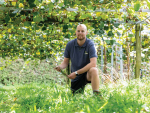
Rabobank Launches HortPathways for Emerging Hort Leaders
Twenty-eight emerging leaders from across the horticulture sector spent two days last month learning valuable skills and connecting with industry experts.




 increase font size
 Rabobank general manager for country banking Bruce Weir.
Free workshops are being offered around the country to help farmers take more ownership of their farm business finances.
The one-day Rabobank Financial Skills Workshops are facilitated by Lawrence Field, from Rural Field Consultants, and are open to both clients and non-clients of Rabobank. Six of the workshops have already taken place this year, with a further 24 scheduled over the remainder of 2024.
Two Financial Skills Workshop modules are available to farmers, with Module One covering stock reconciliations, reading financial statements and what banks are looking for when assessing a farm business, and Module Two covering budgeting, monitoring variances and how to respond if the farm budget deviates from the plan. Attending Module One is not a pre-requisite for attendance at Module Two, however some understanding of financial statements and what lenders look for is desirable.
An initiative of Rabobank’s Client Councils — groups of the bank’s farming clients who meet regularly to discuss issues and implement initiatives to contribute to sustainable rural communities — the workshop series was launched in mid-2021. Since then, over 900 Kiwi farmers have attended one of the more than 60 workshops which have taken place across New Zealand.
Rabobank general manager for country banking Bruce Weir said it was critical farmers and growers had a strong understanding of the financial performance of their business –particularly given the challenging environment industry participants have faced across the past 12 months.
“While we have seen some improvement in agri commodity pricing and farmer sentiment during the early months of 2024, the 23/24 season has undoubtedly been a challenging one for farmers and growers as they’ve grappled with lower commodity prices, high inflation, high interest rates, and the lingering impact of adverse weather events,” he said.
“With this being the case, it is essential farmers know how to read financial statements for their business, and that they understand what levers they can pull under different scenarios to ensure their business is set up for long-term success.
“The workshops do a great job of upskilling farmers in these areas, and I’d strongly encourage farmers to register for an upcoming workshop in their region.”
Weir said participant feedback from recent workshops had been incredibly positive.
“We often find farmers are a little reluctant to sign-up, but once they get to the workshop, they quickly discover other participants have similar knowledge gaps to the ones they do and everyone is there to learn,” he said.
“Our course facilitator, Lawrence, is also really good at making attendees feel at ease and bringing the course content to life. And across the workshops we’ve run in 2024 to date, the average workshop rating we’ve received from participants in their feedback forms is 4.8 out of 5.”
Weir said the bank had recently teamed up with Beef + Lamb New Zealand (B+LNZ) to promote the workshops.
“Our objective is to get as many farmers as possible along to a workshop, so we recently teamed up with B+LNZ and they are now promoting these workshops through their networks,” he said.
“This has helped boost attendance numbers and we’re hoping to see strong attendance at all of the workshops taking place across the remainder of the year.”
More information on upcoming Rabobank Financial Skills workshop and the workshop registration form can be found on the Rabobank website.
Twenty-eight emerging leaders from across the horticulture sector spent two days last month learning valuable skills and connecting with industry experts.

A 'tsunami' of milk from key exporting countries is winding down and this may be good news for New Zealand dairy farmers.
Chinese beef trade quotas and a looming suspension of Brazilian beef imports into the European Union are expected to reshape global beef trade flows over the remainder of 2026, with implications for New Zealand exporters, according to Rabobank's Q3 Global Beef Quarterly report.
New Zealand consumers are paying more for beef mince than ever before, with the average retail price now sitting above $24 per kilogram, according to Rabobank.
West Otago dairy farmer Luke Kane has been awarded the 2026 Rabobank Dr John Morris Business Development Prize.


Federated Farmers has welcomed new rural policies released by ACT, saying they align closely with its own election priorities.

Rural Contractors NZ says proposed changes to land transport rules for agricultural vehicles are a welcome response by the Government to out of date regulations which have seen members hit with huge fines.
Alliance is calling for final applications for its 2027 Graduate Programme, with applications closing on Sunday 25 October.
Decades piloting planes has ensured vet and farmer David Hayes is focused on safety. So, after a serious accident while welding on farm, he is sharing his experience so others can learn from it.
Canterbury milk processor, Synlait Milk has confirmed Leon Fung as its chief executive officer.
OPINION: Making it easier to collect rainwater and use it to grow crops and livestock is a no brainer.





OPINION: The same mainstream media muppets that brought you Jacindamania in 2017 have been flat out pimping for the Opportunities…
OPINION: Your old mate reckons the atrocious way farmers in the UK are treated by their lords and masters in…




