
Federated Farmers Welcomes ACT’s New Farming Policies
Federated Farmers has welcomed new rural policies released by ACT, saying they align closely with its own election priorities.




 increase font size
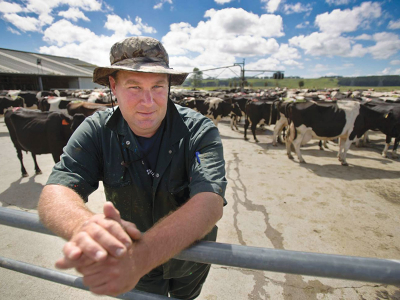 Federated Farmers vice president and climate change spokesperson Andrew Hoggard.
Farmers continue to oppose agriculture entering the Emissions Trading Scheme.
This morning the Government announced that it is joining forces with industry leaders to measure and price emissions at farm level by 2025. Click here to read more.
Federated Farmers says it is pleased to be working with the government via the industry’s ‘He Waka Eke Noa’ commitment, but it does not support agricultural emissions going into the ETS (from 2025 or at any other time) without significant technological and regulatory developments becoming available to farmers.
Federated Farmers supports New Zealand playing its part in addressing climate change by pursuing action consistent with the goals of the 2015 Paris Agreement, including recognizing the fundamental priority of food production.
"He Waka Eke Noa is clear that the ETS has not worked to lower emissions and will not work for agriculture," Federated Farmers vice president and climate change spokesperson Andrew Hoggard says.
"We need more tools in the tool box. We are looking forward to exploring all these avenues further with government.
"New Zealanders also need to realise that any reduction in emissions achieved here through reduced production, will likely only be replaced with production in countries that have higher emissions per unit of output, and usually by subsidised farming sectors," says Hoggard.
Federated Farmers believes the pricing of agricultural emissions (via the ETS or any other mechanism) should only be considered if:
• It occurs at the margin for methane (where additional warming occurs) and not on the inaccurate ‘GWP100’ value.
• It occurs to incentivise the use of a cost-effective mitigation tool that is available, with regulatory approval, to farmers. None are currently available.
• New Zealand farmers are not put at a disadvantage to our main international competitors.
As outlined in He Waka Eke Noa:
"The sector will work with government to design a pricing mechanism where any price is part of a broader framework to support on-farm practice change, set at the margin and only to the extent necessary to incentivise the uptake of economically viable opportunities that contribute to lower global emissions. The primary sector’s proposed 5-year programme of action is aimed at ensuring farmers and growers are equipped with the knowledge and tools they need to deliver emissions reductions while maintaining profitability."
"Our sustainable climate change policy is not only backed by sound national and international science but is also strongly supported by our members.
Feds members have been consulted on numerous occasions, most recently by an online member survey, undertaken in June 2019 which received 1,277 responses.
An overwhelming 96.55% of our survey respondents believe that agriculture should not be in the ETS.
"He Waka Eke Noa represents a cutting edge and grass roots means of lowering new Zealand’s agricultural emissions in an manner that serves as a template to the rest of the world, slugging farmers with another tax via the ETS is simply not," says Hoggard.
Federated Farmers has welcomed new rural policies released by ACT, saying they align closely with its own election priorities.

Federated Farmers is backing Feilding High School’s call to keep Agriculture and Horticultural Science as a standalone subject in Year 11.
National’s pledge to introduce 19 new national standards shows the party is serious about getting Wellington out of farming, Federated Farmers says.
Mobile phone coverage and reliability are deteriorating in rural areas, and farming families are bearing the cost, according to a Federated Farmers survey.
Central Otago District Council (CODC) has voted against a plan to spread treated sewage sludge from Cromwell and Alexandra on farmland near Lauder, a decision Federated Farmers says reflects strong opposition from rural residents.


Federated Farmers has welcomed new rural policies released by ACT, saying they align closely with its own election priorities.

Rural Contractors NZ says proposed changes to land transport rules for agricultural vehicles are a welcome response by the Government to out of date regulations which have seen members hit with huge fines.
Alliance is calling for final applications for its 2027 Graduate Programme, with applications closing on Sunday 25 October.
Decades piloting planes has ensured vet and farmer David Hayes is focused on safety. So, after a serious accident while welding on farm, he is sharing his experience so others can learn from it.
Canterbury milk processor, Synlait Milk has confirmed Leon Fung as its chief executive officer.
OPINION: Making it easier to collect rainwater and use it to grow crops and livestock is a no brainer.





OPINION: The same mainstream media muppets that brought you Jacindamania in 2017 have been flat out pimping for the Opportunities…
OPINION: Your old mate reckons the atrocious way farmers in the UK are treated by their lords and masters in…




