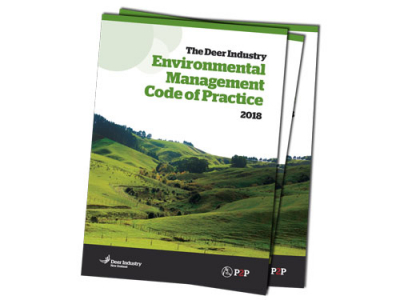

Dr Ian Walker, chair of Deer Industry New Zealand (DINZ), says deer love playing in water and creating muddy wallows, so farmers have had to be creative in order to improve their farm environment.
“Many novel and practical ways to do this are detailed in our new Deer Industry Environmental Management Code of Practice,” he says.
He launched the Code – the first for a New Zealand pastoral industry – at the deer industry conference in Timaru this week.
“It is intended to keep the deer industry at the forefront of efforts to improve water quality. While we strongly encourage farmers to adopt it, we won’t have to do much prodding. Most farmers are already highly motivated to have a great environment on their farms,” he said.
Walker says the NZ Deer Farmers Association first published a Landcare Manual in 2004 that was updated in 2012. The new Code builds on this work.
“It draws many of its case studies from the Deer Industry Environmental Awards initiated by Fiona Lady Elworthy and the late Sir Peter Elworthy in 2000. These awards continue to throw up great examples of the work farmers are doing to improve the environment.”
Walker says much had changed in the last two decades. “While many farmers have fenced off their waterways and retired erosion-prone areas, regional councils, customers, visitors and our fellow New Zealanders want proof that we take our environmental obligations seriously.
“That means having Farm Environment Plans that show we are doing our best to protect soil and water, and ensuring streams, rivers and lakes stay clean. That’s where the new Code comes in. It provides deer farmers drafting a Plan with practical answers to the environmental challenges they face.
“We believe it is realistic to have all deer farmers operating with a Farm Environment Plan by 2020.”
David Morgan, outgoing chair of the NZ Deer Farmers’ Association (NZDFA), farms deer at Raincliff Station, South Canterbury. He says the code is a “fantastic resource” that’s practical and easy to follow.
“Good environmental management goes hand in hand with good animal husbandry. Deer that are healthy, well-fed, not stressed and given the room to act like deer are a lot easier on the environment than a poorly managed herd,” he says.
“I’ve noticed on farms that are actively making changes to improve the environment that they don’t have to wait long before they start seeing results.”
Morgan says it was hard to put a price on the pride that deer farmers feel when they see a healthier stream or more bird life appearing on their property.
The lead authors of the Deer Industry Environmental Management Code of Practice 2018 were Janet Gregory (NZ Landcare Trust) and Edmund Noonan (NZDFA). It was published by DINZ as part of the Passion 2 Profit programme, the industry’s Primary Growth Partnership joint venture with the Ministry for Primary Industries.
The Code is available online at: deernz.org/environmental-management-code-practice