With the debate about reducing the reliance on agrochemical raging on, many manufacturers are looking to control weeds by mechanical means. Kverneland looks to be the latest company to hedge its bets, with the 100% purchase of BC Technique of France, which sells the Phenix Agrosystem brand.
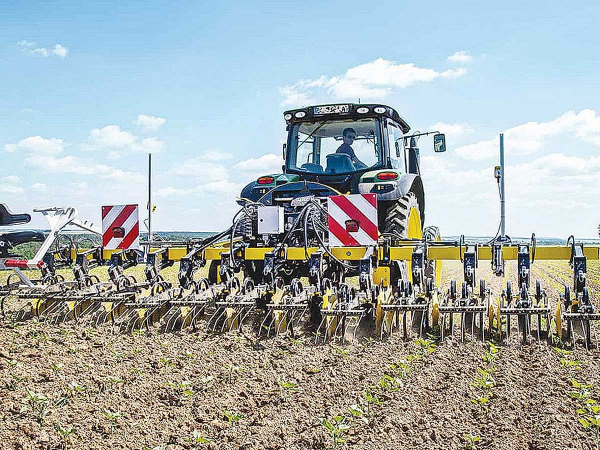
Phenix Agrosystem is a producer of tine harrows, inter-row cultivators, rotary hoes and guidance interfaces.
Its Helios rotary hoe is designed to take out weeds above seed depth. It was originally designed and developed for the organic sector, but more recently the company has moved towards mainstream agriculture as restrictions on herbicides become more stringent, particularly in Europe.
With numerous companies operating in the sector, the French business does seem to have a point of difference. It offers two camera-guided “interface” units, which sit between the tractor and the mechanical hoe to guide the implement down the rows independently of the tractor.
The guidance system can be used in conjunction with any brand of implement. Named Lynx and X-Green the system removes the need to invest in a separate system for each machine being used, although they will still require their own camera systems.
The company also reports that the purchase also allows Kverneland access to a 400ha pilot tillage farm for machine development in the Bourgogne region of central France. This is where Phenix Agrosystem implements are designed and tested over a wide variety of soil types and conditions – a valuable resource for its new parent company.
<p">In other Kverneland news, accuracy and precision continue to evolve for the company’s extensive range of iXter A and B mounted alongside the T3, T4 and T6 iXtrack trailed models.
Three new optional features include SpotSpray, the introduction of a 25cm nozzle spacing option; and the next generation Boom Guide ProActive boom height control.
SpotSpray technology is an extension of the company’s variable rate application maps, used on seed drills and fertiliser spreaders with task control, so will apply to sprayers that are equipped with iXspray software, using the iXflow Air/iXflow E individual nozzle control.
SpotSpray uses treatment maps that are preloaded into the control terminal to instruct the sprayer to automatically control individual nozzles through the SpotSpray software and GPS, to apply the correct product doses to the pre-defined areas.
Operators can define areas such as weed infestations, wet spots, areas of non-germination or parts of a paddock with known soil problems. As a result, spray costs can be reduced, but also protecting healthy crops from unnecessary blanket applications.
The introduction of a 25cm nozzle spacing option alongside lower boom heights can be achieved to further reduce spray drift to a minimum.
Working at a reduced boom height of 30cm instead of 50cm, has been made possible with the latest generation of Boom Guide ProActive ultrasonic boom control. This uses advanced sensor technology to be able to deliver greater precision and consistent boom control at higher forward speeds.