Tackling Leptospirosis
Leptospirosis is one of the most significant health threats to New Zealand dairy herds and the families who work with them.




 increase font size
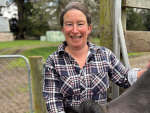
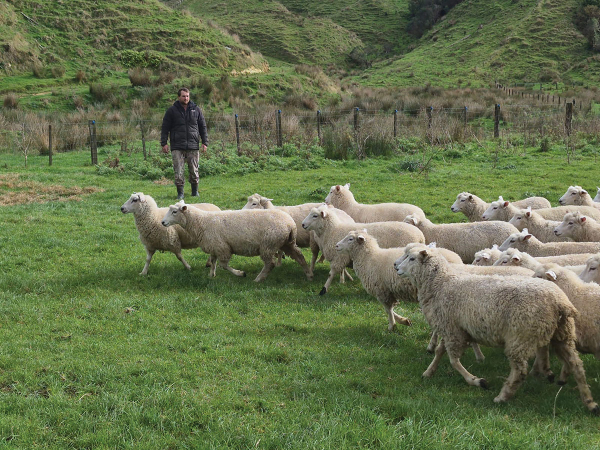 Stephan Turner moves vaccinated ewes on the family’s Piopio sheep and beef farm.
Clostridial diseases are a major cause of sudden death in young lambs and calves, and for King Country farmer and veterinarian, Stacey Turner, vaccinating with Ultravac 5in1 is a non-negotiable animal health practice.
Stacey and her husband Stephan farm Stephan's family property at Piopio, where he is the third generation to farm the land.
The couple has purchased some of the 290-hectare effective sheep and beef farm and lease the balance, with a goal to purchase more in the future.
The farming operation is diverse, with 1000 breeding ewes and about 80 breeding cows. They also trade some stock and rear autumn born calves and fatten bulls.
Stacey, who is originally from Australia, moved to Piopio to work as a vet, where she met Stephan. She practices full-time as a mixed animal vet, predominantly with sheep and beef farmers.
The couple uses the Zoetis Ultravac range in their own operation to vaccinate ewes pre-lambing and cows pre-calving, as well as giving it to lambs at docking, and again pre-weaning or at weaning time. Calves are given Ultravac at disbudding time, and again as a booster.
"In my opinion, clostridial diseases are very common and are an unnecessary loss when there's a very successful and affordable vaccine out there. For me, it's a no brainer for lamb and calf survival," Stacey says.
The closer to lambing and calving the vaccine is administered, the better. They usually give it two to four weeks prior to lambing.
"This increases the antibodies lambs and calves get in the milk from mum."
Stacey explains that clostridial diseases include things like tetanus, pulpy kidney, black leg and botulism.
They are a toxin present on the pasture that animals ingest, usually resulting in sudden death.
"And it's usually your nice, big fast-growing animals that tend to like to die."
Vaccination is both an insurance policy and delivers good return on investment, she says.
"A lot of farmers don't give it at docking or weaning, but for the cost of the vaccine, it's a good insurance policy. I would never not give it. It's all about increasing survivability - the more animals you have, the more money you make.
"Before we routinely used clostridial vaccinations for ewes, you might see twins or triplet bearing ewes with lambing problems, and that's the perfect time for clostridial diseases to take hold. You only have to lose one ewe and that's $500 and $600, which is far greater than the cost of a pack of vaccine."
Stacey says for youngstock, clostridial disease is often m ore common on lush, faster growing pastures, which can be a problem for highly productive farms.
"Those that have lambs on crops with high protein content or lush feed can have greater incidence of death from clostridial diseases. Often with bulls, if they are fighting, they can have bruising or wounds that increase the chance of clostridial disease as well. So, some farming systems are more prone to issues.
"Clostridial diseases are the diseases you often see with your bigger, faster growing animals and there is probably a correlation with what they are eating, or the feed they are on."
Being able to administer the vaccine at key times when animals are in the yards for other procedures, like docking, means it is labour efficient and doesn't require any extra manpower.
Stacey also values the ability to add trace elements, like selenium or B12, to Ultravac.
"You're not having to give multiple treatments. B12 is closely related to growth rates and we give our lambs the vaccine with B12, which I love. It's great to have the ability to give extras but still only one jab, that's a big win."
As a vet, this also allows her to tailor recommendations to individual farms and their systems.
Some farms may only need 5in1, while others like to give selenium to ewes with the pre-lamb vaccination.
"I can tailor my approach to that farm with the same product; it's not one size fits all. Farms with selenium deficiency, for example, can get white muscle disease in lambs, so adding selenium to the vaccine might be a good option,"
Article supplied by Zoetis
Leptospirosis is one of the most significant health threats to New Zealand dairy herds and the families who work with them.
Drench Options are become increasingly limited for sheep farmers, highlighting the importance of proactive parasite management planning within the wider farm system to stretch the longevity of drench as a tool.
When Simon Hales discovered triple drench resistance on his Weber farm, it was a catalyst to fast-track farm system change.
Solid biosecurity practices, regular monitoring and timely vaccination are the three key pillars of effective Bovine Viral Diarrhoea (BVD) control on New Zealand farms. Zoetis veterinary technical advisor, Karley DeFrees, explains BVD is a costly but preventative disease that impacts a significant number of dairy farms in New Zealand. Implementation of a BVD control plan can help protect your herd from this avoidable disease.
Healthy, well-grown calves are the building blocks of any future dairy herd. Giving them the best start to life is crucial, and the primary strategy to reduce the burden of disease caused by rotavirus infection is vaccination.


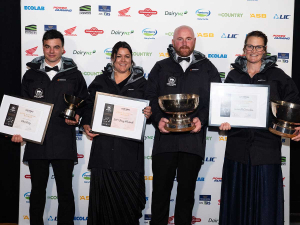
Entries opened on Monday, 5 October 2026 for the 2027 New Zealand Dairy Industry Awards (NZDIA), which organisers describe as the nation's biggest celebration of excellence in the dairy sector.
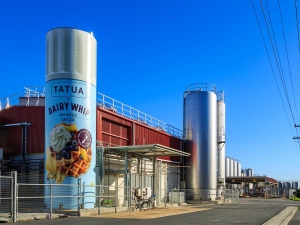
Waikato milk processor Tatua has again declared a record milk payout to farmer shareholders, leaving other processors in the dust.
A Labour-led Government won’t be bringing back the controversial freshwater rules of 2020.
National’s much-touted free trade deal with India featured in the Rural Issues Debate at Mystery Creek, Hamilton on Wednesday night.
New Zealand's 2026-27 freshwater fishing season has opened, with anglers encouraged to head to rivers and lakes over the coming days as conditions look favourable across much of the country.
Central Otago District Council (CODC) has voted against a plan to spread treated sewage sludge from Cromwell and Alexandra on farmland near Lauder, a decision Federated Farmers says reflects strong opposition from rural residents.





OPINION: The same mainstream media muppets that brought you Jacindamania in 2017 have been flat out pimping for the Opportunities…
OPINION: Your old mate reckons the atrocious way farmers in the UK are treated by their lords and masters in…