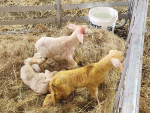
Beef + Lamb NZ's Lambing Kit Checklist for a Tough Season
With lambing underway in many regions, Beef + Lamb New Zealand is encouraging farmers to put together a wellequipped lambing kit to help minimise lamb losses, particularly in bad weather.




 increase font size
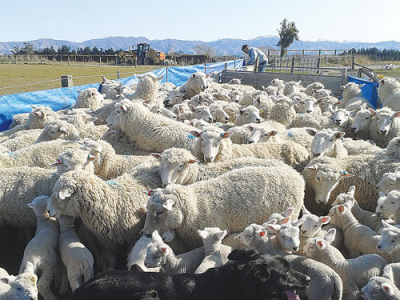 Australian research has found that a calm temperament in ewes improves both ovulation rate and more successful pregnancies.
A calm temperament in ewes improves ovulation rate and successful pregnancies, according to a study published by The University of Western Australia (UWA).
The study involved researchers from Uruguay, Australia’s Department of Primary Industries, Regional Development WA and the university.
They investigated the reproductive outcomes of 200 Merino ewes known to have either a calm or a nervous temperament. They found the ovulation rate and rate of successful pregnancies to be higher in the calm ewes.
Associate professor Dominique Blache from UWA’s School of Agriculture and Environment and Institute of Agriculture who led the study said temperament affects ovulation rate but not the occurrence of ovulation.
“Differences in reproductive outcomes between the calm and nervous ewes were mainly due to a higher ovulation rate in calm ewes,” she said.
“Even when the ovulation rate is maintained, some of the nervous ewes have problems in maintaining their pregnancy possibly because of the quality of the eggs and subsequent embryos, and perhaps the quality of the uterine environment during the first two weeks of pregnancy.”
The researchers say understanding why the reproductive outcome of these ewes is different will help to breed sheep better suited for the production system and improve their welfare.
The study found that behavioural reactivity affects ovulation rate, but not the occurrence of ovulation. Therefore, any differences in reproductive outcomes between the calm and nervous ewes were mainly due to a higher ovulation rate in calm ewes.
It also discovered that some of the nervous ewes, when the ovulation rate is maintained, have problems in maintaining their pregnancy. This is possibly because of the quality of the oocytes and subsequent embryos, and perhaps the quality of the uterine environment during the first two weeks of pregnancy.
As plasma concentrations of progesterone post-AI were not affected by temperament, but insulin and leptin concentrations were, the researchers suggest that reproduction in nervous ewes is compromised by factors leading up to ovulation and conception, or in the uterine environment during early pregnancy – that reflect differences in energy utilisation.
The paper, Calm Merino ewes have a higher ovulation rate and more multiple pregnancies than nervous ewes was published in the journal Animal. The research was supported by Meat and Livestock Australia.
With lambing underway in many regions, Beef + Lamb New Zealand is encouraging farmers to put together a wellequipped lambing kit to help minimise lamb losses, particularly in bad weather.
Will a stronger, more coordinated voice help rebuild confidence and improve returns in the wool sector?
The vineyards at Pyramid Farm in Marlborough’s Avon Valley have never been run of the mill, with plantings that follow the natural contours of the land, 250 metres above sea level.
Sheep and cattle numbers continue to decline, and this year's drought hasn't helped, according to Beef + Lamb New Zealand (B+LNZ).
A Christchurch manufacturer of woollen covers for newborn lambs says his covers pay dividends in survival rates and liveweight gains, especially at a time when farmers are feeling the economic pinch.



Federated Farmers has welcomed new rural policies released by ACT, saying they align closely with its own election priorities.

Rural Contractors NZ says proposed changes to land transport rules for agricultural vehicles are a welcome response by the Government to out of date regulations which have seen members hit with huge fines.
Alliance is calling for final applications for its 2027 Graduate Programme, with applications closing on Sunday 25 October.
Decades piloting planes has ensured vet and farmer David Hayes is focused on safety. So, after a serious accident while welding on farm, he is sharing his experience so others can learn from it.
Canterbury milk processor, Synlait Milk has confirmed Leon Fung as its chief executive officer.
OPINION: Making it easier to collect rainwater and use it to grow crops and livestock is a no brainer.

OPINION: The same mainstream media muppets that brought you Jacindamania in 2017 have been flat out pimping for the Opportunities…
OPINION: Your old mate reckons the atrocious way farmers in the UK are treated by their lords and masters in…




