New Zealand and Ireland Extend $34.5m Climate Research Partnership for Agriculture
Ireland and NZ have concluded a deal to extend a joint research programme on climate change.




 increase font size
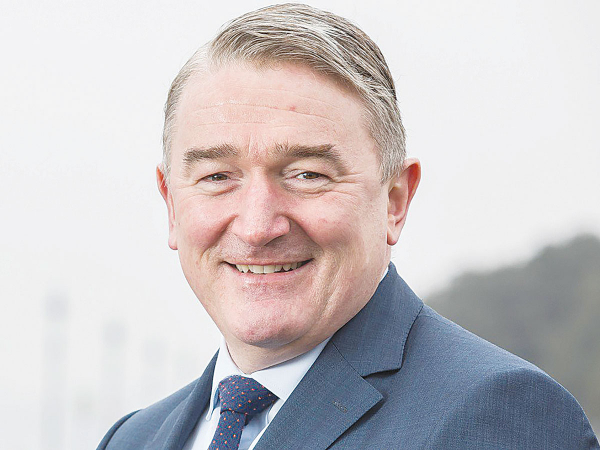 Ornua chief executive John Jordan.
The global pandemic has boosted growth opportunities for grass-fed dairy products.
That’s the view of Ornua (formerly Irish Dairy Board) chief executive John Jordan. Speaking at the recent Pasture Summit New Zealand-Ireland Forum, Jordan noted that Covid-19 has changed consumer perspective and buying patterns and they want transparency around brands.
“They don’t want to be told a made-up story and find out that it is fake,” he says.
“There’s been a great resonance in integrity and that’s as important in dairy as in any part of our lives. Dairy, through Covid, has been seen as a positive part of our diets.”
Jordan says Ornua’s key dairy markets have performed strongly over the past 18 months, cementing the position of grass-fed dairy products among consumers.
“We genuinely believe that Ireland and New Zealand are the two countries remaining with predominantly grass-fed dairy systems,” he says.
"That is a real point of difference, and we must leverage that."
Jordan says the difference is tangible and can be seen in grass-fed dairy products like Kerrygold butter and cheese compared with grain-fed products.
The Irish grass-fed difference is behind the global success of Kerrygold butter and cheese.
The Kerrygold brand is now worth €1 billion and is Ireland’s most successful food brand. It is the number one butter and cheddar brand in Germany and the number two butter brand in the US. About 10 million packets of Kerrygold butter and cheese are sold around the world each week.
Jordan says being the number two butter brand in the US makes him smile.
“This little island off the West Coast of Continental Europe and we are the number two butter behind Land O’ Lakes in the entire US,” he says.
Jordan points out that being a co-operative is important and helps them put some rules and regulations around the Kerrygold trade.
Any dairy product in the world that carries the Kerrygold brand name means that the “dairy element” has been produced in Ireland, he says.
“It might be packed abroad – but it’s Irish dairy product from Irish milk from Irish farming families.”
He says Kerrygold is a great asset and real value added for the Irish dairy sector.
Jordan says Kerrygold is sold on the promise of being made from milk from Irish grass-fed cows and having a premium quality and superior taste.
“It’s the Irish grassfed difference that makes the difference,” he claims. “Irish cows graze outdoors for most of the year and grass-fed cow’s milk is rich in natural beta-carotene.”
Irish Dairy Boom
The Irish dairy industry took off after the end of the European Union quota system that had capped milk production in member states.
Ornua chief executive John Jordan says about €500 million worth of new stainless steel was put into the Irish dairy industry to prepare for the influx of milk.
“The processing plants we have are state-of-the-art and operate to a very high standard, they’ll match anybody on a global scale,” he says.
Jordan says this is backed by Irish farming families producing worldclass grass-fed milk and Ornua which markets Irish dairy products to consumers.
Irish dairy produces mostly ingredients and consumer and food service products. It has processing plants around the world – Europe, the US, Saudi Arabia and Africa.
Jordan notes that Ornua has little presence in Asia… “probably acknowledging the strength New Zealand has in that market.”
Ireland and NZ have concluded a deal to extend a joint research programme on climate change.
Ireland's Minister of state for Agriculture says it’s hard to explain to Irish farmers the size and scale of NZ farms.
The Irish Minister of State for Rural Communities says his country and New Zealand face very similar challenges on a range of issues related to agriculture, including climate change, biodiversity and rural depopulation.
In the rural landscapes of New Zealand and Ireland, a shared agricultural heritage thrives, built on a strong mixture of tradition and innovation, with mirror image climates earning both countries global acclaim for their food quality and sustainable agriculture.
MPI director general Ray Smith reckons NZ has a lot to learn from the Irish Agriculture and Food Development Authority – called Teagasc (pronounced ‘Chog us’).


Mark Hooper has been appointed the new chair of NZPork, the industry organisation representing New Zealand pig farmers.
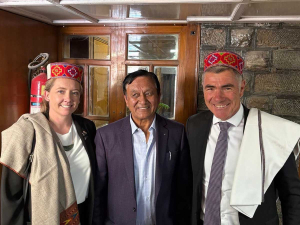
As the India-New Zealand free trade agreement enters into force, New Zealand’s apple industry has reaffirmed its commitment to the long-term development of India’s apple sector.
Fonterra shareholders can begin voting on Tuesday 20 October in the 2026 Board of Directors’ election, a Co-operative Council election in one Ward, and seven Annual Meeting resolutions.
National’s pledge to introduce 19 new national standards shows the party is serious about getting Wellington out of farming, Federated Farmers says.
The National Party’s policies to make it easier to grow fresh vegetables, secure reliable water and energy and simplify farm planning are practical changes that will give growers the confidence to invest, according to Horticulture New Zealand (HortNZ).
Fonterra Co-operative Group chief financial officer Andrew Murray has resigned to take up a role outside the dairy giant.

OPINION: It seems Canterbury processor Synlait is still in the doldrums.
OPINION: Get offside with New Zealand First leader Winston Peters at your own peril.




