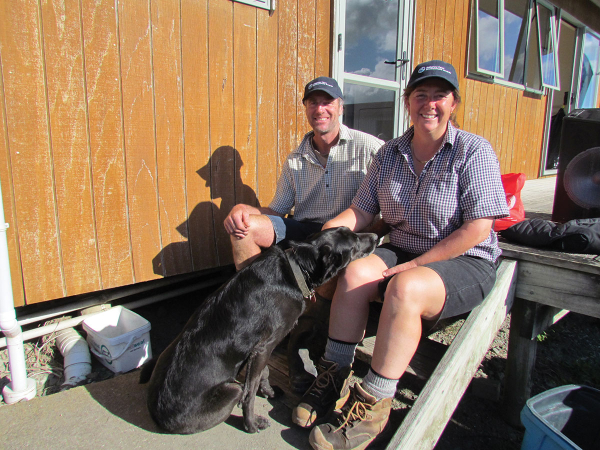
The bumpy road you travel on teachs you a lot, believes Don Watson. And that’s the message he and wife Kirsten, supreme winners of the Auckland Ballance Farm Environment Awards, aim to pass on to their three sons.
“They were a big motivation as to why we went farming,” he told a field day at their South Head farm, Morelands Pastoral, in late May.
From Veterinary Careers to Farming Success
Both of them trained and worked as vets before going sheep and beef farming then taking on two sharemilking positions. Kirsten admits they bought their 123ha (112ha effective) farm “on the hop” back in 2017.
“But we haven’t regretted it. It’s become a passion project for us.”
They also lease a 150ha runoff just over the road, which is cropped for maize silage and where they run their heifer replacements, all of which they breed themselves using LIC sexed semen, and some beef cattle.
Breeding for Efficiency and Sustainability
There are no bobby calves with Rissington Profitmaker composite semen being used for easy-calving and low birthweight offspring.
Target production for the split-calving Kiwicross herd this season is 135,000kg milksolids with around 400kg of palm kernel and one tonne of maize silage/cow fed annually.
Transforming Kikuyu-Dominant Pastures
Kikuyu-dominant pastures have been improved through mulching, trialling six different fescues, the best of which have delivered 2 t/ha more feed, and improving the soil structure. In their first year pasture harvest wasn’t 8 t/ha but that’s now up to 12-13 t/ha.
Innovative Water Management Delivers Results
On 12ha of waterlogged flats they made a switch from 120 kg/ha nitrogen prills to first 70 kg/ha N foliar applications and now 40 kg/ha. There wasn’t enough fall for a floodgate but a novel solution was found through local Waimauku inventor, Tom Gardiner.
He demonstrated his water siphon on the farm which creates a vacuum allowing water to be drained from higher to lower levels at the same time as going up and over obstacles eight metres high. While Don was dubious he now sees that the cost of around $45,000 with the top siphon unit leased from Tom, is highly efficient. Around 4-500 cubic metres/hour of water can be removed meaning after an overnight storm, water levels are back to normal in the morning. There’s been a 30% lift in pasture harvest.
Halter Technology Transforms Farm Management
Another innovation which has paid off handsomely is the use of Halter, where again he said he was initally a sceptic. But they calculate the technology saves 27 hours/week of his time and it’s made a huge difference when it comes to mating management and monitoring body condition score (BCS).
They’ve also made environmental improvements through upgrading their effluent system. One third of the flats is irrigated by travelling cannon, while on the hills, stationery guns are automatically shifted every hour. The existing effluent pond had a stainless steel shield added to hold solids back, which can easily be scraped out and spread on the cropping land.
Fallow deer that come out of the tidal mangroves are a problem, as is pampas, which Don said takes a lot of effort to target. With one small Queen Elizabeth II bush block on the farm, funding has been received from Kaipara Moana Remediation (KMR) to plant a steep face with kanuka, manuka, totara and cabbage trees. Wetlands are also in the process of being created as a suitable habitat for the endangered bittern, a regular visitor.
The Watsons also took out the Ballance Agri-Nutrients Soil Management Award, the DairyNZ Sustainability and Stewardship Award, the Hill Labs Agri-Science Award, the Norwood Farming Efficiency Award and the Beef + Lamb New Zealand Livestock Farm Award.