
Boosting Crop Production by Spreading Effluent
Tararua district farmer Jamie Harris milks around 400 cows using a split calving system on his farm, Crossdale Dairies.




 increase font size
 The flexible film construction is said to have strong mechanical properties, resists chemicals and is backed by a five year warranty.
With ever tightening regulations on effluent storage, containment – whether in open ponds or purpose built reservoirs – is capital intensive.
An alternative solution from TechniPharm presents a cheaper option.
The Ecobag system, developed by Dutch specialist Wiefferlink Group, consists of a contained bladder-type structure which requires only minimal earthworks in the shape of a sump or earth banks for support, and is tethered by a system of retaining straps and ground anchors.
The company claims various advantages: preservation of nutrients, because the sealed bladder suffers none of the evaporation that occurs from open pond structures; no odours, useful if residential areas are nearby; and no entry of groundwater or rainwater.
The set-up is also said to prevent crust formation, and mixing is done by a self-contained stirrer.
The flexible film construction is said to have strong mechanical properties, resists chemicals and is backed by a five year warranty.
Installation costs can be as low as $37/m3 as against a more likely cost of around $60/m3 for a traditional open pond system.
Available in sizes from 1000-10,000 cubic metres.
Tararua district farmer Jamie Harris milks around 400 cows using a split calving system on his farm, Crossdale Dairies.
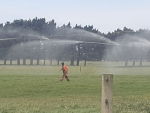
Water management is an integral component of sustainable farming practices, according to Watermetrics.
Two farmers and two farming companies were recently convicted and fined a total of $108,000 for environmental offending.
A Taupiri farming company has been convicted and fined $52,500 in the Hamilton District Court for the unlawful discharge of dairy effluent into the environment.
Founded in Germany as recently as 1977, today, the Fliegl Group employs more than 1100 workers, offering an expansive range of transport solutions, from their base in Bavaria.



National’s pledge to introduce 19 new national standards shows the party is serious about getting Wellington out of farming, Federated Farmers says.
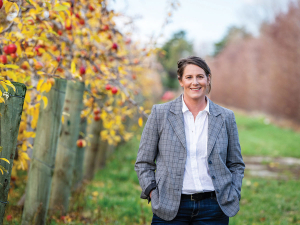
The National Party’s policies to make it easier to grow fresh vegetables, secure reliable water and energy and simplify farm planning are practical changes that will give growers the confidence to invest, according to Horticulture New Zealand (HortNZ).
Fonterra Co-operative Group chief financial officer Andrew Murray has resigned to take up a role outside the dairy giant.
A major move is about to get underway to improve the quality and viability of dairy beef and cattle in NZ.
Veterinarians say changes to the code of welfare for dairy cattle provides a positive foundation for improved cattle welfare across the country.
Today, 15 October, is the International Day of Rural Women, which recognises rural women’s contribution to farming, communities and the environment.




OPINION: It seems Canterbury processor Synlait is still in the doldrums.
OPINION: Get offside with New Zealand First leader Winston Peters at your own peril.




