Inside the Southland Dairy Farm Where Robots and Pasture Work Together
In Dacre, near Invercargill in New Zealand’s South Island, Bruce Dinnington is running a dairy operation unlike any other.




 increase font size
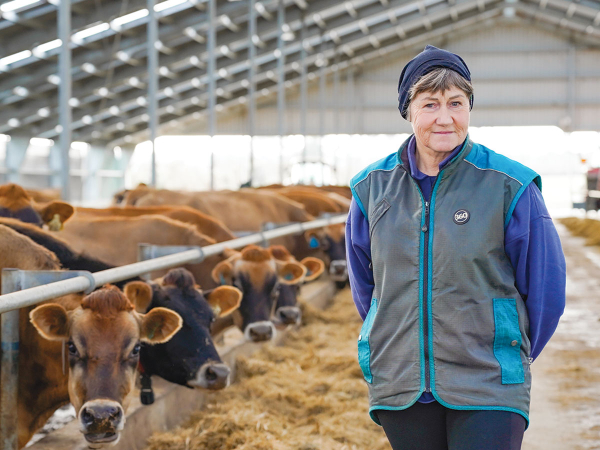 Joanne Crack of Southern Star Farms, Invercargill.
In the beautiful, scenic expanse of Invercargill, Joanne (Jo) Crack of Southern Star Farms is redefining what it means to run a modern, self-sufficient dairy operation.
The Crack family manages a 456 hectare farm near the Waituna Lagoon. As part of this, Jo balances a 350 to 370-strong Jersey cow herd alongside 2000 ewes and some beef stock.
The farm’s transition from a conventional system to an automated grazing setup powered by four Lely Astronaut A5 robots has completely revitalised their business and family lifestyle.
Southern Star Farms didn’t always look this way. Jo and her family started on a smaller, conventional dairy farm further up the road, milking up to 400 cows in an old herringbone shed. While they loved the industry and the animals, they quickly discovered two major pain points: they disliked the day-to-day grind of putting cups on cows, and they did not want to manage outside staff.
The logical step was to bring the cows home to their main property, downsize the herd slightly to focus on efficiency, and let automation take over the labour. Now, the dairy unit thrives at the top of the farm, while the sheep occupy the bottom acreage closest to the lagoon.
The transition has empowered Jo to manage the bulk of the dairy operation mostly by herself. When peak seasons arrive, family support steps in seamlessly. Her husband, Darrin, helps train heifers in the mornings and evenings, and the second generation - daughter Kimberly and daughter-in-law Annabel - can walk in and run the system with zero formal training.
“The system is pretty easy to follow,” Jo notes, explaining that she simply leaves a list on the wall for them to reference.
Operating on a peaty soil base that naturally keeps the animals above the mud, Southern Star Farms features a highly strategic grazing layout. Nearly four years ago, they added a barn to the property to protect the pastures and house the winter milkers during Southland’s frequently rough weather spells.
While the farm originally launched with a three-way grazing model, Jo quickly realised that optimising cow flow required an upgrade to a strict four-way grazing system (A, B, C, and D blocks). Under this system, the herd spends exactly six hours in each even break across a 24-hour period.
According to Jo, keeping the blocks perfectly identical is the secret to a steady, predictable robotic system. If the allocations are uneven, cow flow becomes erratic, causing large groups to bottleneck at the lounge. By utilising four even intervals, the cows achieve an optimal milking frequency of two to three times a day, voluntarily spreading their traffic evenly across the day and night.
One of Joanne Crack's greatest passions is cow genetics, and the Lely system has completely transformed her breeding programme. Dissatisfied with catalogues - where bulls are marketed as “robot ready” but fail to perform under real-world automated conditions - Jo took matters into her own hands.
By extracting deep data from her Lely Horizon management software, Jo meticulously monitors metrics like milk speed, culling information, and the performance of specific cow families. This level of granularity simply isn’t available in conventional systems, or even in large rotaries according to her.
“The last few years I’ve actually been keeping bulls from those families, and the resulting progeny, there’s no surprises with them,” Jo says. “They milk exactly as I expect them to and generally better than anything I get out of the catalogues.”
This customised breeding approach has driven consistent, yearon- year production increases without expanding the herd size. Seeing her top Jersey cows regularly achieve 800 to 900 kilograms of milksolids has set a new benchmark for what her entire herd could achieve.
Reflecting on their journey, Jo stands firmly by a sentiment she shared back in 2024: “If we hadn’t put in the robots, we wouldn’t be dairying right now. Robots have given us freedom and taken the stress away.”
Today, that statement remains entirely accurate. The automation allows the family to handle a highly diversified workload - including raising all their own Jersey replacements, selling yearling bulls, growing out beef crossbreeds, and managing their own cultivation and muck spreading - without burning out.
Looking ahead, Jo sees virtual fencing as the next evolutionary step for their property, which would allow her to shift grass breaks right from her phone and potentially explore batch-milking groups to minimise cow walking distances.
In Dacre, near Invercargill in New Zealand’s South Island, Bruce Dinnington is running a dairy operation unlike any other.
Getting calves away to a strong start means attention to detail from day one, so the Lely Calm, an automatic drinking system for calves, prepares and feeds rations at the right temperature and is designed to ensure calves receive smaller, more frequent portions throughout the day.
The first weeks of a calf's life quietly shape the future of the entire herd.
Since its decision to concentrate on milk harvesting and animal husbandry, resulting in the selling of its agricultural machinery brands and factories, Lely’s focus seems to be paying off with a growing business.
With 2025 marking the 30th anniversary of its first milking robot being installed in Belgium in 1995, Lely says it has taken automated milking to the “next level” with the release of the latest version of the Astronaut Series - the A5-Next.

OPINION: New health and safety guidance unveiled by the Government recently provides farmers greater certainty about what is expected of them when managing risks on farm.

The National Animal Welfare Advisory Committee (NAWAC) is seeking public feedback on proposed changes to the Code of Welfare for Rodeos.
A New Zealand initiative supporting farmers to restore the health of grazing landscapes has received international backing through the Regenerative Fund for Nature, a global collaborative fund supporting regenerative agriculture and the communities that produce natural fibres for the fashion industry.
Combine premium New Zealand products, blend in a family ritual and what do you get? A world-class functional drink.
Entries are now open across eleven regions for the 2027 New Zealand Dairy Industry Awards (NZDIA).
Safer Farms is urging farmers to make sure everyone working on farm has safe, suitable footwear for the job.
OPINION: It seems Canterbury processor Synlait is still in the doldrums.
OPINION: Get offside with New Zealand First leader Winston Peters at your own peril.