
Calf Shed Hygiene Starts with Chemistry
Good Calf shed hygiene has always been about providing clean, dry bedding.




 increase font size
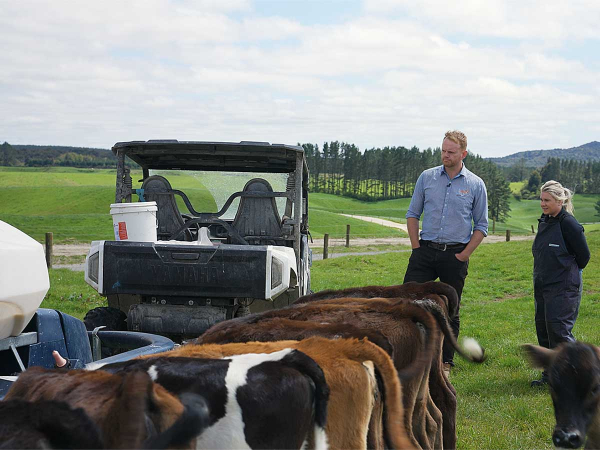 Matt Collier checking Nicole Oppert’s calves being fed 8 litres of milk once a day.
Matt Collier, Probiotic Revolution, says calves will drink a lot of milk once-a-day with their probiotic Calf Xtreme.
Collier says the abomasum of a new-born Friesian calf is only 1.2 litres, so with big feeds, the milk spills into the calf’s rumen.
He says Calf Xtreme has been developed to turn this into a positive.
“We’ve refined the probiotic strains, so calves avoid nutritional scours.
“At the same time, we’re establishing beneficial bacteria in the rumen at a young age, improving digestion of meal, hay and grass.
“Therefore, the intake of hard feed is not limited by high milk volumes, they simply grow faster and post weaning intake of grass is higher.”
Near Te Puke, Nicole Oppert, along with her husband Kevin, rears 200 crossbred heifer replacements on their 260 hectare equity farm purchased two years ago, as well as supervising another 200 calves on a second equity property. Nicole has always reared calves on a once-a-day system.
“On day one we offer them 5 litres of gold colostrum. By day three they can be drinking 6-7 litres of milk, so they get to 8 litres once a day by 8 to 10 days of age. Then we maintain that level until weaning.”
Nicole has always reared calves on a once-a-day system and has had 7 years’ experience using Calf Xtreme.
“It allows for a huge increase in milk volume and despite the extra milk, the intake of hay meal and grass also goes up significantly. Our heifers are much bigger at calving, and we’ve had no calving difficulties this year.”
Growth rates before and after weaning have also impressed.
Collier says Friesian calves consuming 7-8 litres once a day by around 10 days of age are averaging close to 1kg of liveweight gain per day from birth to Christmas – indicating no post weaning check.
While early growth is encouraging, Collier believes the real value comes later.
“The objective isn’t simply heavier calves at weaning. Faster early growth leads to better-developed heifers entering the milking herd, and that’s where the production gains can be realised.”
DairyNZ guidelines indicate first-calving heifers typically produce around 75-80% of the milk solids achieved by mixed-age cows.
Collier cites an example of a Stratford farmer who used Calf Xtreme to change from feeding 2 litres twice a day to 7 to 8 litres once-a-day by day 10. “Research shows better tissue is being laid down in the udder in the first five weeks of a calf’s life and they are still growing better after weaning
off milk.
“On this farm heifer milk production compared with mixed age cow production has lifted from 74% to 86%. That’s a lift of 50kg milk solids per heifer”
As more farmers look for ways to improve labour efficiency as well as improve heifer milk production, once-a-day feeding programmes supported by nutritional technologies are attracting increasing attention across the dairy sector, Collier adds.
Good Calf shed hygiene has always been about providing clean, dry bedding.

OPINION: Succession and long-term planning are perennial topics because it is perpetually sidelined on busy farms.
By September, pre-mating heat recording is underway on many spring-calving dairy farms.
OPINION: The stats speak for themselves.
Farms across the upper North Island are trialling different pasture mixes as part of a research programme that aims to build greater resilience into farming systems.


Federated Farmers has welcomed new rural policies released by ACT, saying they align closely with its own election priorities.

Rural Contractors NZ says proposed changes to land transport rules for agricultural vehicles are a welcome response by the Government to out of date regulations which have seen members hit with huge fines.
Alliance is calling for final applications for its 2027 Graduate Programme, with applications closing on Sunday 25 October.
Decades piloting planes has ensured vet and farmer David Hayes is focused on safety. So, after a serious accident while welding on farm, he is sharing his experience so others can learn from it.
Canterbury milk processor, Synlait Milk has confirmed Leon Fung as its chief executive officer.
OPINION: Making it easier to collect rainwater and use it to grow crops and livestock is a no brainer.
OPINION: It seems Canterbury processor Synlait is still in the doldrums.
OPINION: Get offside with New Zealand First leader Winston Peters at your own peril.




