
Diplomatic Incident
OPINION: Your old mate hears an international incident is threatening to blow up the long-standing Anzac alliance as Kiwis and Aussies argue over who wants new Australian resident and former NZ Prime Minister Jacinda Ardern.




 increase font size
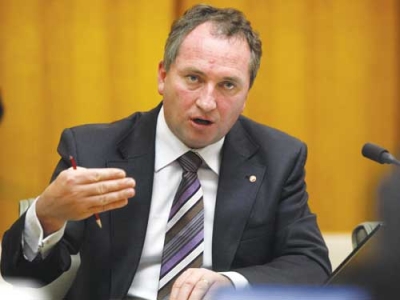 Australian Agriculture Minister Barnaby Joyce.
Australian farmers can look forward to a A$1.2 billion boost to farm incomes and more drought assistance as part of the recently released Federal Government’s long awaited agricultural competitiveness white paper.
The paper, unveiled by Prime Minister Tony Abbott and Agriculture Minister Barnaby Joyce in early July, foreshadows A$728 million extra for existing and new investment and a further A$500 million to develop new dams over four years.
Delivering the paper was a key Coalition pre-election pledge and a draft green paper released in October last year foreshadowed changes to taxation arrangements and better access to finance.
The paper also commits to extending drought assistance concessional farm loans by a further A$2.5 billion over 11 years.
“The Commonwealth Government’s agricultural competitiveness white paper is an investment in our farmers and our… strengths in agriculture,” Prime Minister Tony Abbott says.
“A strong agricultural sector contributes to a strong economy, and that means more jobs, more exports, higher incomes and better services to the community.”
Agriculture Minister Barnaby Joyce said the Government was “determined to make the sector more competitive and deliver practical actions that will keep our farmers profitable and resilient”.
The package contains A$500 million to develop new dams including pre-feasibility studies, and expands the farm management deposits [FMD] scheme. This enables farmers to better average their incomes by setting aside pre-tax income in good years for drawing on in lean years.
It will be extended to smaller farms and for the first time used as an offset against farm loans. The concession is estimated to cut farmers’ interest costs by up to $150 million a year.
The maximum allowable deposit limit will be lifted from A$400,000 to A$800,000 from July 1, 2016. The package also includes A$11.4 million to establish a special agriculture commissioner on the Australian Competition and Consumer Commission to encourage fair trading in the sector, a further A$200 million boosting R&D, A$200 million to boost biosecurity surveillance and A$30 million to break down technical barriers to trade.
Abbott also hailed the Government’s success in North Asia free trade agreements as boosting farm exports; the Government is still pursuing the US-led Trans-Pacific Partnership (TPP).
The TPP would cover 40% of the world’s economy (including NZ). It aims to set sweeping new rules for trade and investment – tariffs, quotas, intellectual property, labour, the environment and state-owned enterprises.
OPINION: Your old mate hears an international incident is threatening to blow up the long-standing Anzac alliance as Kiwis and Aussies argue over who wants new Australian resident and former NZ Prime Minister Jacinda Ardern.

OPINION: Your old mate hears that at a recent China Business Summit, PM Christopher Luxon delivered a none-too-subtle "could try harder" report card on the red meat industry regarding its exports to China - particularly when compared to Australia.
More Australian states are embracing virtual fencing technology, opening growth opportunities for Kiwi companies like Halter.
Fonterra says its ongoing legal battle with Australian processor Bega Cheese won’t change its divestment plans.
Farmers in the Australian state of New South Wales will soon be able to use virtual fencing and herding technology to boost farm productivity.


Federated Farmers has welcomed new rural policies released by ACT, saying they align closely with its own election priorities.

Rural Contractors NZ says proposed changes to land transport rules for agricultural vehicles are a welcome response by the Government to out of date regulations which have seen members hit with huge fines.
Alliance is calling for final applications for its 2027 Graduate Programme, with applications closing on Sunday 25 October.
Decades piloting planes has ensured vet and farmer David Hayes is focused on safety. So, after a serious accident while welding on farm, he is sharing his experience so others can learn from it.
Canterbury milk processor, Synlait Milk has confirmed Leon Fung as its chief executive officer.
OPINION: Making it easier to collect rainwater and use it to grow crops and livestock is a no brainer.




OPINION: The same mainstream media muppets that brought you Jacindamania in 2017 have been flat out pimping for the Opportunities…
OPINION: Your old mate reckons the atrocious way farmers in the UK are treated by their lords and masters in…




