
China No Longer Just A Commodity Story - Luxon
China remains New Zealand’s biggest market, taking $23 billion of our exports, but it’s no longer a commodity story, says Prime Minister Christopher Luxon.




 increase font size
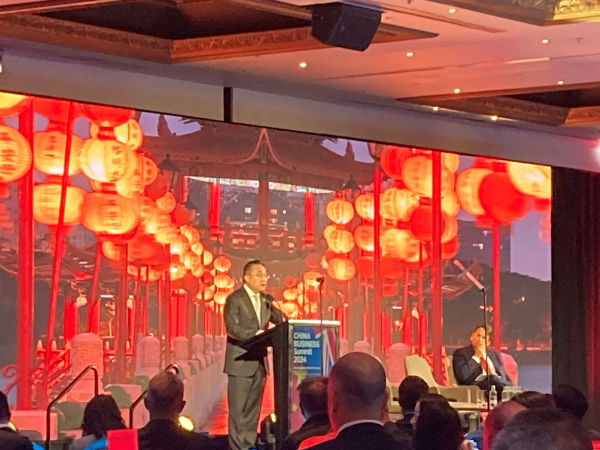 Chinese Ambassador Wang Xiaolong.
China’s Ambassador Wang Xiaolong says bilateral economic and trade cooperation between China and New Zealand has made significant and rapid progress.
Speaking at the China Business Summit in Auckland today, Xiaolong says China has been New Zealand’s largest trading partner, largest export market and largest source of import for over ten years.
“Working together has delivered tangible benefits to the two countries and two peoples. In fact, the footprint for the evolution of our economic ties is closely correlated to the trajectory of China’s own reform and opening up, which has been a consistent and powerful source of expansion in our bilateral trade.
“China has grown to become the second largest economy in the world, and by some measures, it is already the largest. Its economic transformation has nurtured an increasing number of middle-income earners, a maturing super-sized market, with rising appetites for quality products and services.
“China’s trade in goods has ranked first globally for seven years in a row. It is also the major trading partner for over 140 countries and regions including New Zealand.
Xiaolong touched on China’s economy, dubbed by some commentators as struggling.
But he says as for China’s economic outlook, intriguingly, there are now in some Anglo-Saxon media two diametrically opposing narratives.
“One says that China has already peaked as an economy, and some naysayers even come to the conclusion that China is on the brink of imminent collapse. The other says that the Chinese economy is so strong as to threaten flooding the rest of the world with its “overcapacity”. By common sense, these two opposing narratives cannot be right at the same time. Going deeper, they are, in fact, both wrong.
“Let’s first unpack the so-called “peak China” theory. Indeed, the pace of the country’s economic growth has slowed somewhat in recent years, but the Chinese economy, defying both internal and external headwinds, managed to register a 5.2 percent year-on-year growth in 2023, faster than most other major economies. It is no small feat for a 30 trillion-dollar economy.
“And according to the latest data, the country’s GDP grew by 5.3% year-on-year in the first quarter of 2024, and from January to April this year, China’s foreign trade value registered a growth of 9.8% year-on-year, faster than widely anticipated.”
He says for many years, China has contributed more than 30% on average to world economic growth.
“Looking into the future, China will remain an important powerhouse driving global growth for many years to come. The IMF’s latest report forecasts that for the next five years, meaning through 2029, China will contribute at least 21% of global growth, bigger than all the G7 countries combined.
“More importantly, the Chinese economy is now undergoing profound transformation, focusing more on high quality development rather than high speed growth. This means we’ll actively and effectively promote higher-quality growth while increasing economic output in the coming years.
“What’s even more significant is that high-tech industry in China has grown exponentially, with new quality productive forces emerging at an accelerating pace. China’s total input in research and development, and investment in the high-tech sector have been growing at double-digit rates for several years running, enabling China to take the lead in the number of patent applications in increasing technology clusters.”
China remains New Zealand’s biggest market, taking $23 billion of our exports, but it’s no longer a commodity story, says Prime Minister Christopher Luxon.

Fonterra is strengthening its foodservice presence in China with the launch of a new cream for professional bakeries at Bakery China 2026 in Shanghai.
OPINION: What does the birth rate in China have to do with stock trading? Just ask a2 Milk Company.
Additional tariffs introduced by the Chinese Government last month on beef imports should favour New Zealand farmers and exporters.
One of the most galling aspects of the tariffs whacked on our farm exports to the US is the fact that, now more than ever, US farmers are being propped up by government welfare – a direct result of Trump’s hardline on its trading partners.



National’s pledge to introduce 19 new national standards shows the party is serious about getting Wellington out of farming, Federated Farmers says.

The National Party’s policies to make it easier to grow fresh vegetables, secure reliable water and energy and simplify farm planning are practical changes that will give growers the confidence to invest, according to Horticulture New Zealand (HortNZ).
Fonterra Co-operative Group chief financial officer Andrew Murray has resigned to take up a role outside the dairy giant.
A major move is about to get underway to improve the quality and viability of dairy beef and cattle in NZ.
Veterinarians say changes to the code of welfare for dairy cattle provides a positive foundation for improved cattle welfare across the country.
Today, 15 October, is the International Day of Rural Women, which recognises rural women’s contribution to farming, communities and the environment.





OPINION: The same mainstream media muppets that brought you Jacindamania in 2017 have been flat out pimping for the Opportunities…
OPINION: Your old mate reckons the atrocious way farmers in the UK are treated by their lords and masters in…




