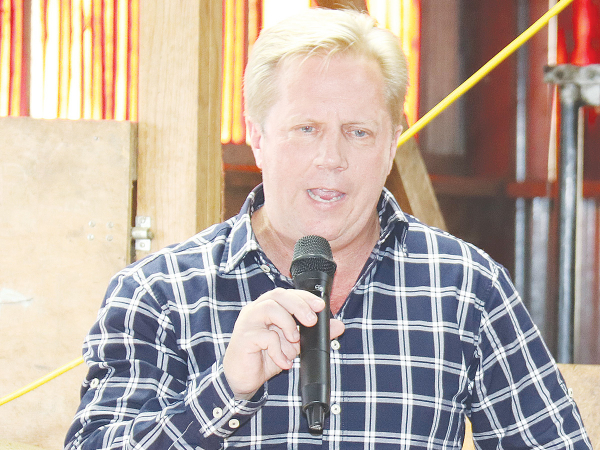
National's newly-minted agriculture spokesman Todd McClay says the public services need a change of mindset when it comes to dealing with the primary sector.
Speaking along with his boss Christopher Luxon at a recent 'wool-shed' meeting in Hawke's Bay, McClay says the public service seems to think that the way to solve a problem in rural areas is to make more rules - regardless of the cost impact of these. He says some of these rules are quite unworkable in practical sense.
Instead, McClay believes bureaucrats need to understand that fewer and better rules that have less of a financial impact on farmers is the correct solution.
"Take, for example, the winter grazing slope rules," he told the audience of farmers. "They said the whole country should have a blanket rule with a 10-degree slope rule and you can't winter your animals there to feed them - unless you pay money to get a resource consent. Well, that's a mad rule."
McClay accepts that there is a need to protect the environment and waterways but believes a catchment-by-catchment approach is a better way to protect soils close to waterways.
The Hawke's Bay meeting attended by the two local National candidates, Catherine Wedd and Katie Nimon, is clearly part of a strategy by the party to shore up the rural vote, some of which could be siphoned off by ACT.
McCla emphasises that National sees agriculture as one of its top priorities. He says, as well as strengthening rural economies, it plays a vital role in earning money that provides for other important things - such as health and education. He also put out a call for people to stop unfairly criticising farmers.
"Instead, people should be championing the rural sector, not vilifying it."
At the meeting, people were keen to hear Christopher Luxon talk not only about farming but other areas of concern to rural communities - such as health and education. His promis to reduce the number of regulations drew applause.
Luxon says his goal is for agriculture to grow by 2% a year and says, if it does, there will be an extra $50 billion in the government coffers by 250.
"I want people to focus on how we grow this sector more and not burden it with more regulations," he says.