Boosting Crop Production by Spreading Effluent
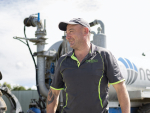
Tararua district farmer Jamie Harris milks around 400 cows using a split calving system on his farm, Crossdale Dairies.
 increase font size
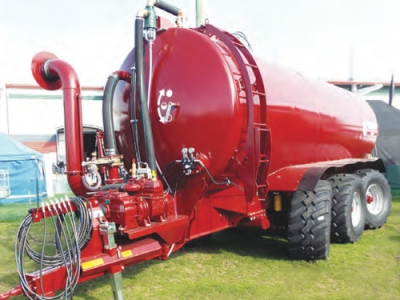 Giltrap’s vacuum slurry tanker.
Dairy effluent, particularly slurry, can be a big problem.
As environmental pressures increase, there's no doubt that New Zealand's dairy farmers will need to take a close look at their existing systems, and learn to understand the nutrient value of this by-product.
Big problems need big solutions, and they don't come much bigger than the Giltrap Engineering vacuum tanker shown on their Fieldays site. With a capacity of 20,000 litres, 8.5 metre length, 3.2 metre height and a tare weight of 7.7 tonnes, this behemoth should certainly make a large hole in the effluent pond during the working day.
Manufactured from 6mm plate steel the tank is supported along its full length by a heavy duty integrated chassis, the superstructure is carried on a HD tri-axle bogie system, with steered front and rear axles, fitted with oversized tyres, and offering hydraulic braking on all six wheels to stop progress safely.
High spec European componentry is used throughout and includes a Battioni Pagani rotary vane vacuum pump featuring auto lubrication to deliver 12,000 litres per minute output to fill the beast in less than two minutes. Pump protection sees a double moisture trap layout, whilst all fittings are either brass or heavily galvanised steel for corrosion protection and an extended operating life
Internally the tank is fitted with a reinforced baffle plate to prevent liquid surging as the tank empties, and offers twin manhole access points for easy entry to facilitate cleaning and maintenance. Around the machine, three filling points are fitted as standard, which use 200mm sectional hoses for rapid filling.
Shown at Fieldays with optional sprung axles, and the operator friendly Autofill system, the range is offered with a 3 year warranty for peace of mind, and can be customised with a range of accessories to suit individual operating requirements.
Tararua district farmer Jamie Harris milks around 400 cows using a split calving system on his farm, Crossdale Dairies.
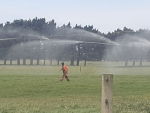
Water management is an integral component of sustainable farming practices, according to Watermetrics.
Two farmers and two farming companies were recently convicted and fined a total of $108,000 for environmental offending.
A Taupiri farming company has been convicted and fined $52,500 in the Hamilton District Court for the unlawful discharge of dairy effluent into the environment.
Founded in Germany as recently as 1977, today, the Fliegl Group employs more than 1100 workers, offering an expansive range of transport solutions, from their base in Bavaria.
New Zealand dairy farmers are set to be the first in the world to receive access to a new digital physical milk pricing tool that enables them to fix the price for their physical milk.
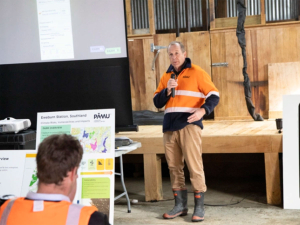
State farmer Pāmu is opening its farm gates this summer in an effort to give the rural sector the opportunity to see how large-scale, multi-system farming is delivering productivity and profitability across New Zealand.
A five-year study has found that the cost of reducing emissions without technology may be significant and unsustainable for Northland dairy farmers.
DairyNZ says Waikato farmers need certainty on Plan Change 1, but they say that certainty must be matched with practical, workable rules and a clear transition that doesn't get ahead of the new resource management system currently under review.
While the Government has moved quickly to make commercial hauliers' lot easier during the current fuel crisis, they appear to be stuck in the creep box when it comes to the agricultural industry.
Waikato farmers have been told that the Government’s new planning system legislation and the region’s Plan Change 1 (PC1) “won’t mesh together very well”.