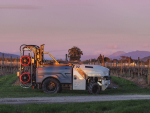
Picking kiwifruit on orchards may be about to get easier.
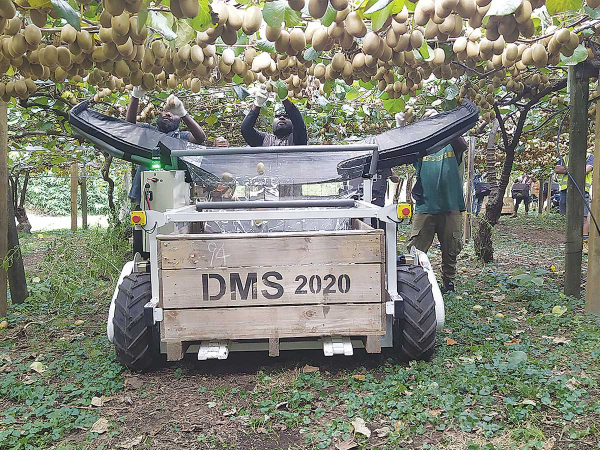
The University of Waikato has developed an award-winning electronic fruit bin that assists in the harvesting of kiwifruit to help make picking lighter work.
The e-Bin is being validated in trial work this season and likely to be commercialised soon after.
The e-BIN human assisted harvesting project has been a collaboration with Zespri, the project sponsor. It has also involved students and academics from the university’s School of Engineering and industry experts.
Headed by engineering lecturer Nick Pickering, its aim is to enlarge the potential labour supply by creating technologies which reduce the physically- demanding aspects of Kiwifruit harvesting.
Pickering says he approached Zespri with some innovative ideas and then co-developed their on-orchard automation strategy.
Assisted harvesting was one of the opportunities identified as a stepping-stone to full automation.
‘’Watching videos and researching the challenge during the October 2021 lockdown we quickly saw the demanding physical nature of the harvesting job with the majority of workers being under 30.
“At the same time we were hearing about unemployment in the regions. So we thought, let’s build something that expands the demographics of the picking workforce and try and kill two birds with one stone by creating augmented robotics that create jobs in our regions."
Pickering says successful innovation often requires hitting the ‘sweet spot’ of technical feasibility, user desirability and financially viability.
“The industry is suffering serious labour shortages especially during harvest, so we’ve come up with this solution that can enable more people to do the job of picking kiwifruit.”
Pickering says the e-Bin aims to be technically feasible, financially viable and desirable for all stakeholders.
“The key factor is we needed something simple that can be commercialised quickly to help address the labour shortages we’re seeing.”
He says picking kiwifruit can be physically demanding work, as people are required to carry a large bag that they fill as they pick. Once filled, it can weigh about 25kg and then it needs to be emptied into a larger bin.
The e-Bin takes the hard work out of picking the fruit.
Instead of each individual having to carry around a bag, a group of four pickers walk alongside the e-Bin, which is on wheels. As each kiwifruit is picked, it is dropped into a fruit catcher on the e-Bin. A net cushions and secures the fruit, before it rolls down and comes to rest in the main bin.
Zespri Innovation Leader of Orchard Technology Peter McHannigan says there’s potential to solve many issues with assisted robotics but they must make commercial sense.
“Through this project we are looking at the total financial cost-benefit assessment.”
Pickering says the e-Bin has been put to the test, first with 3D printed fruit and then out in the field, with researchers looking at a number of factors including productivity and fruit damage. The results are promising in terms of the e-Bin’s ability to reduce fatigue and safely operate in an orchard environment.
“It’s a basic concept and it links the desirability, financial feasibility and practicality in a very simple solution really – as all we have done is removed the weight.”
The e-Bin was recognised at the Fieldays Innovation Awards, taking out the Prototype Award and a cash prize of $10,000.