From South Africa to NZ: Afimilk Success Story
Twenty years ago, South African dairy farm manager Louis Vandenberg was sent to a farm in Waikato to provide training on Afimilk technology.




 increase font size
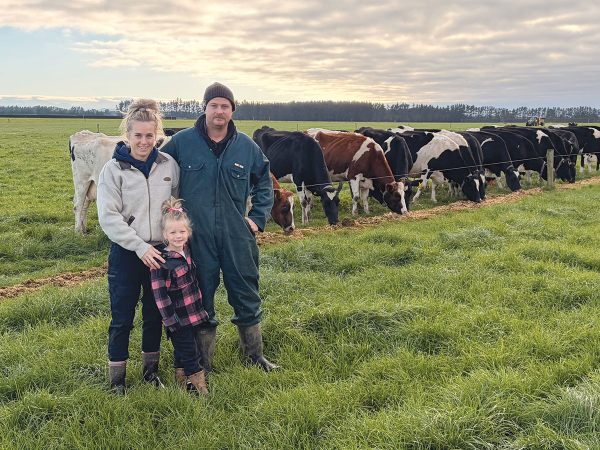 Farmers, Sian Meijer and Rick Wobben with daughter Fleur.
For Canterbury dairy farmers Sian Meijer and Rick Wobben, wearable technology has become one of their most valuable on-farm tools - helping manage 1850 cows across an expansive, high-performing dairy operation while improving efficiency, mating outcomes and day-to-day decision making.
Together with Rick’s parents, Roel and Diana Wobben, they operate a large-scale dairy business at West Eyreton, near Rangiora, where technology and genetics work hand-in-hand to support productivity and profitability.
The operation, originally converted from a deer farm in 2000, milks through two sheds across two adjoining farms, but is managed as one unit.
The introduction of Afimilk AfiCollars two seasons ago has added another layer of precision to an already highly organised system.
“We’re always looking for ways to improve,” Sian says.
“The collars have become another tool that helps us take the farm to the next level.”
Rick and Sian are currently contract milkers for Roel and Diana, in their fifth season on the property.
The scale of the farming operation means management is complex. The “big shed” peak milks up to 1200 cows through an 80-bail rotary fitted with GEA ACR cup removers, Protrack and Afimilk technology.
Meanwhile, the “little shed” has the same technology in a 60-bail rotary and feed pad system and is home to the younger and lighter cows.
“That’s where the 450-500 heifers calve in spring and where we top up with lighter cows to approximately 600 to 650 total, season-dependent,” Sian says.
The farm split-calves, with around 1550 cows calving in spring and 250-300 cows calving in autumn. Autumn-calving cows are milked through winter, while carryover empties and sound culls boost milk production until August 1, when all cows leave the little shed and move over to the big shed.
Five full timers are employed at the big shed, and three full timers at the little shed. Additionally, three-four full-time, fixed term staff are brought on board during the busy periods of the season.
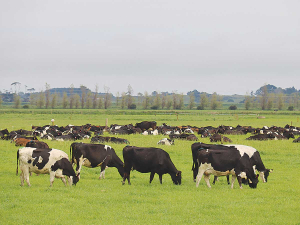
The predominantly Holstein Friesian farm produced 986,000 kgMS last season, and they are closing in on a milestone they’ve had in their sights from the beginning.
“We’ve hit record after record and we’re on track to produce 1,000,000 kgMS this season,” Sian says. “When we started here, Rick told Roel he wanted to hit one million milksolids. Roel kind of chuckled and said, ‘Go ahead.’ Now, we’re almost there.”
Despite the large herd size, the family remains focused on breeding functional, efficient Holstein Friesian cows suited to their farming system.
“The perfect cow for us is a Holstein Friesian that’s not too big, but still does the milk,” Sian says. “We want a cow with a big engine room, good udders and strong fertility. Herd genetics is one of our passions.”
The herd is approximately 95% straight Holstein Friesian and increasingly, red genetics are becoming a feature of the herd as well.
“We love a red factor,” Sian says. “If they tick all the boxes, we’d pick red over black and white every time. About 20 percent of
the herd has a red
factor now.”
When walking through the herds, they check records to see what Holstein Friesian sires they have used that they are particularly impressed with, the type and functionality the family values showing in their offspring.
Twenty years ago, South African dairy farm manager Louis Vandenberg was sent to a farm in Waikato to provide training on Afimilk technology.
It was love that first led Leah Prankerd to dairying.
Balclutha farmer Renae Martin remembers the moment she fell in love with cows.
Showcasing a legacy of innovation and cheap deals on product lines will be the feature of Afimilk’s site at the National Fieldays this month.
Afimilk, a global dairy farm management solutions provider, has appointed Justin Miller as the new general manager for New Zealand and Australia.


High country stations, mixed sheep and beef farms, Māori-owned farms, corporates and family operations are among the nine commercial farms taking part in the Livestock Innovation Farming Transformation programme, known as LIFT.
OPINION: New health and safety guidance unveiled by the Government recently provides farmers greater certainty about what is expected of them when managing risks on farm.
The National Animal Welfare Advisory Committee (NAWAC) is seeking public feedback on proposed changes to the Code of Welfare for Rodeos.
A New Zealand initiative supporting farmers to restore the health of grazing landscapes has received international backing through the Regenerative Fund for Nature, a global collaborative fund supporting regenerative agriculture and the communities that produce natural fibres for the fashion industry.
Combine premium New Zealand products, blend in a family ritual and what do you get? A world-class functional drink.
Entries are now open across eleven regions for the 2027 New Zealand Dairy Industry Awards (NZDIA).

OPINION: It seems Canterbury processor Synlait is still in the doldrums.
OPINION: Get offside with New Zealand First leader Winston Peters at your own peril.




