Marlborough Grower Melissa Tripe on Surviving the Downturn
Melissa Tripe knows what a downturn feels like.




 increase font size
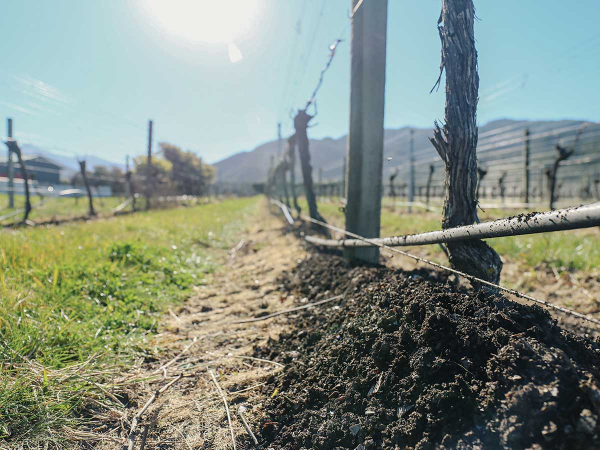 Returning organic matter and its nutrients to vineyard soils.
Thousands of tonnes of Marlborough winery waste could be transformed into a valuable resource for vineyards through a new regional programme led by Bragato Research Institute.
The Marlborough Circular Wine Programme will collect winery lees from participating wineries, and combine it with materials such as compost and biochar to produce a safe, beneficial soil amendment that provides value to growers. “Marlborough wineries produce large volumes of solid and liquid lees, which is currently treated as waste,” says BRI Sustainability Research Leader Dr Seth Laurenson, who is leading the programme. “Our goal is to create a coordinated regional system that safely returns that organic matter and its nutrients to vineyard soils.”
Large volumes of lees, the sediment left over from winemaking, are produced over a relatively short winemaking period during and after vintage. They can be expensive to dispose of and place pressure on regional wastewater and waste-management infrastructure. As disposal costs rise and environmental expectations increase, Marlborough wineries need a more sustainable regional alternative. Participating wineries will pay the programme a disposal fee designed to be competitive with landfill costs, while the finished product will be returned to participating vineyards at no additional cost. There has been 18 months of groundwork, and a ‘go early phase’ from May 2026, which saw the programme capture lees from the 2026 vintage, with 650 tonnes processed at a Kaituna site. Over the next four years, the programme aims to divert more than 3,000 tonnes of solid lees from landfill and wastewater systems each year, mitigating around 4,700 tonnes of CO₂-equivalent emissions. “This programme is an excellent example of the wine industry, researchers and government working together to solve a costly waste problem and turn it into a regional resource,” says Seth.
BRI and its science partners will lead the scientific testing, quality assurance and system design needed to demonstrate that the model is sustainable and practical at commercial scale. The programme will also develop a business case for establishing a permanent regional facility.
The initiative has “so many positives”, says Rose Family Estate (RFE) Winemaker Nick Entwistle, who is part of the Circular Wine Programme and has worked on different lees solutions in the winery for nearly 10 years. “We felt that if we found a regional solution that everyone could get involved in, we’d get some economies of scale, it would be a lot more efficient, a lot less labour intensive for wineries, and an ultimate win for the environment as well.”
RFE previously spread its lees throughout its vineyards, after mixing it with grape marc to get appropriate concentrations. But that means storing lees throughout the year, until harvest provided the marc “carrier”. Other smaller companies might compost it during the year, while larger operations send it to landfill, because they don’t have capacity to spread it back in the vines, Nick says. He has sent RFE’s lees to the facility this year, and will send bentonite lees soon. “It’s a lot easier, and we can send it in five or six tonnes at a time, rather than accumulating 50,000 litres of lees.”
The Marlborough Circular Wine Programme is the first initiative of its kind at commercial scale in New Zealand’s wine sector, Seth says. “If we can demonstrate a safe and commercially viable model in Marlborough, the approach could provide a blueprint for other wine regions.”
The four-year programme represents a combined investment of $6.98 million, with government investing $2.79m through the Primary Sector Growth Fund, alongside $4.19m in co-investment from New Zealand Winegrowers and participating wineries. The programme is also supported by The Green Circle and Marlborough District Council.
Sarah Rowley Adams is the Communications Manager, BRI.
Melissa Tripe knows what a downturn feels like.
Glyphosate resistance threatens to significantly increase operational costs and reduce profitability in New Zealand vineyards, according to a new report.
From genetic researchers and bioinformaticians to plant pathologists and data scientists, Emma Jenkins talks to some of the women helping shape the future of New Zealand wine.
Bragato Research Institute has announced funding for four new research projects, all aligned with BRI's Research Strategy, designed to be completed within one to two years, and expected to deliver near term benefits for growers and winemakers.
OPINION: The months ahead are important for New Zealand Winegrowers.



OPINION: As I approach three months in my role as New Zealand Winegrowers Chief Executive, one message has come through…

OPINION: The United States wine market has changed forever, and companies cannot use same old playbook, said Erin Kirschenmann at…
One of Australia's most decorated winemakers will speak at the Aotearoa New Zealand Chardonnay Symposium in Hawke's Bay this September.
The third Aotearoa New Zealand Chardonnay Symposium will be underway in Hastings, Hawke's Bay, on 17-18 September.
Vintage 2026 yielded excellent fruit for most New Zealand wine regions.