Both sires are top picks among farmers seeking strong udders in their replacement heifers.
Earl says LIC first became interested in Dembe’s grandmother about six years ago, and a bull out of her was sold through contract mating.
“At that time, I was just starting to do a bit of embryo transplant work… we had some really good results, and found ourselves with eight heifer calves from her,” Earl says.
“One of those heifer calves was Dembe’s mother; she was contract mated as a yearling.”
This year, LIC’s sire selection team has purchased five bulls out of Earl’s herd.
Having satisfied all genomic evaluation benchmarks, all five young sons will progress through LIC’s Sire Proving Scheme this year.
Read More:
The evidence is strong, and Earl knows he’s breeding good dairy progeny. How’s he doing it?
Selection pressure key
Mating the yearlings to elite young sires is an acknowledged method of fast-tracking genetic gain, but so too is selection intensity within a herd, a tactic that’s not lost on Earl.
“In terms of genetic improvement within our herd, the number-one driver has been selection pressure, and by that I mean getting plenty of cows in calf and reducing wastage, enabling us to sell a portion of budget cows at the end of most seasons.
“For the last few years we’ve had good six-week in calf rates in the high 70s, and because of that we’ve been able to chop between 20 and 50 cows out of the bottom each year – and we’re making those selection decisions primarily on production worth (PW).”
This follows the mantra of herd improvement specialists, professional farm consultants, top commercial farmers, and fellow breeders: ‘Breed on gBW, cull on PW’.
“We nominate our bulls,” Earl said. “I do make picks from Premier Sires (tables) but I don’t take them as a team, I nominate them within a pack, and they’re primarily genomic bulls.
“And we’ve always mated our heifers to AB.”
Utilising genomic bulls over young stock fast-tracks genetic gain because the very latest genetics are being used, which are generally better than the previous generation of bulls and heifer calves.
In addition, time is not lost waiting for daughter proofs (i.e. herd testing information) to filter through, because DNA information (through GeneMark Genomics, for example) can identify whether desirable milking traits, such as fat and protein, have been passed on to the calf.
A solid performer
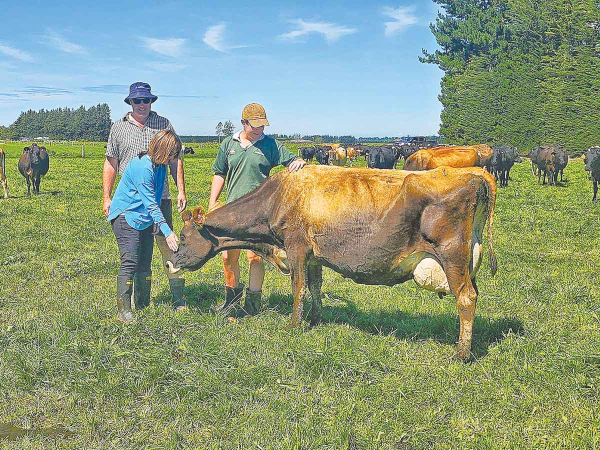
Earl typically milks 765 crossbred cows during the season through a 54-bail rotary. He and wife Melissa farm 240ha of flat Canterbury land, and aside from themselves (Melissa helps during peak calving season), the couple employs three fulltime staff.
The farm is owned by the McSweeneys alongside equity partners.
Dembe’s mother is still a core part of the herd, Earl said.
“She’s a four-year-old… she’s performing well, she’s got better with age actually, and she’s right up there with the best among the herd.
“It’s a family that’s performed very well for us; we sold (to LIC) two more bulls this year out of the same family.
“She’s 427 (gBW) and 635 production worth, and she’s probably a 470kg cow.
“She did 600kg solids as a 3-year-old last year. And that’s in a herd that’s doing an average of around the 490kg mark; they’re (i.e. the family’s daughters) producing well above their peers.”
Goal setting
On average the herd was producing about 105% of its liveweight, which equated to 490kg milksolids per cow, Earl said.
“All our top cows are doing well above that – our quartile one group is probably doing about 130% of their liveweight, and my agri manager Pete de Vill helps me out with that sort of data.
“We want our top cows to be staying in the herd until they’re 8- and 9-year-olds.
“You could say it’s our five-year goal to bring our whole herd to 110% of their liveweight, while maintaining our current farm system.”
Mating Plan
Recent mating plans have seen about 60% of the herd bred back to dairy replacements, with the remaining 40% of the herd going to beef (utilised from day 1 of the mating plan).
Cows were targeted based on gBW, Earl McSweeney said.
“From week 6 to week 10 we use SGL. We’ve gone AB right through this year. We’ve invested in CowManager tags six months ago, so it’s made it a lot easier.
“We scanned (the cows late January), and we maintained our six week in calf rate (mid-70s).”
Replacement calves were managed on a runoff within 10km of the farm, Earl said. “We weigh the young stock and all the data goes to MINDA Weights. Every time we drench, we weigh.”
Although the farm didn’t weigh milking stock, Earl said it was a strong consideration as it would make his genomic breeding worth information more robust.
The McSweeneys are also breeders of another top genomic bull that LIC has catalogued this year, 524059 Plateau Grayson-ET, another Spectacular son.