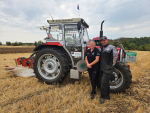
NZ Ploughing Team to Use Borrowed Gear After Shipping Mix-Up
The New Zealand ploughing team to the world championship in Croatia next month will be banking on borrowed equipment as they seek glory.




 increase font size
 Irish National Ploughing Championships
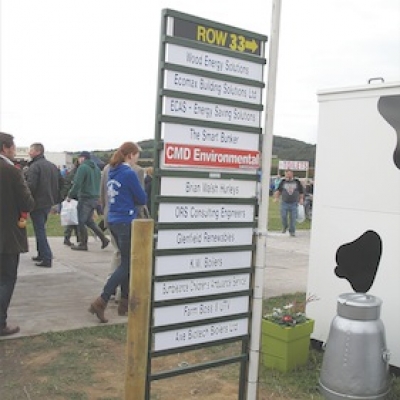
MASSIVE CROWDS and excellent site facilities distinguished the Irish National Ploughing Championships at Ratheniska, Stradbally, County Laois, 100km NW of Dublin, in September.
The annual event is held at the same site for two successive years, concurrent with the national machinery and equipment field days.
The 2014 ploughing championships was the 83rd such event. Interest in ploughing was high, the Republic of Ireland’s two entrants in the world championships having just returned from competing in France. Eammon Tracey won the conventional world title, after gaining third in the previous year. John Whelan in the reversible section gained third after winning the world championships the previous year.
The Irish competition is huge compared with the New Zealand event. At least 280 ploughmen and women competed in about 20 classes. This includes the Farmerette conventional plough class for women (12 entries), and many women competing in open divisions.
Allied to the ploughing competition, as part of Ireland’s farming festival, is the Irish equivalent of our National Fieldays. But there any comparison ends.
In Ireland’s biggest annual event, the ploughing match, machinery and exhibits combine to promote all that is best in Irish exporting and supplies for agricultural and urban communities.
Total attendance at the three-day event was 279,500 – 82,000 on the first day, 102,000 on day two and 95,500 on the last day. For comparison, last June’s National Fieldays attracted about 120,000 over four days. Exhibitors at the Irish event numbered 1400 – about double the Fieldays.
Getting through the crowd was a challenge, but helped by excellent walkways covered by aluminium panels called Trakway.
“The National Ploughing Association spends upwards of €500,000 (NZ$810000) annually on Trakway,” the managing director/secretary of the Ploughing Association of Ireland, Anna May McHugh, told Rural News. “But it’s essential, allowing all the movement we could ever require for exhibitors, machinery and the public before, during and after the show.”
The Trakway panels are 3 x 2m and some 85,000 have been laid – 5ha of covered ground – ensuring access to all sites is clear and free of mud. “With Ireland’s reputation for wet weather combined with our crowds the area could quickly turn to a disaster,” McHugh said.
Even the bus areas had Trakway covered paths so patrons could arrive and leave in comfort. The panels are removed with special machinery three weeks after the show finishes.
Next year’s event will be held in Country Carlow.
The New Zealand ploughing team to the world championship in Croatia next month will be banking on borrowed equipment as they seek glory.
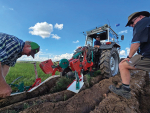
Ploughing champions Mark Dillon and Malcolm Taylor earned the right to represent the country at the World Ploughing Championships in Osijek, Croatia, on 5 and 6 September, after winning their titles at the New Zealand Ploughing Championships in Middlemarch in 2025.
Ireland and NZ have concluded a deal to extend a joint research programme on climate change.
Ireland's Minister of state for Agriculture says it’s hard to explain to Irish farmers the size and scale of NZ farms.
The Irish Minister of State for Rural Communities says his country and New Zealand face very similar challenges on a range of issues related to agriculture, including climate change, biodiversity and rural depopulation.


During the nesting season, from September to December, industrious starlings can quickly build nests in the darker areas behind tractor and vehicle, usually close to hot engines, typically resulting in localised damage or in some cases complete write-offs.
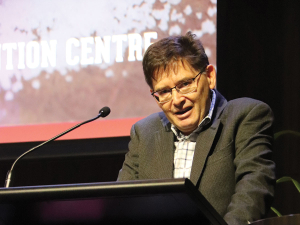
The meat processing industry is much more collegial than it was in the past and is now more focused on common goals.
With the last couple of months having seen some potential tractor purchases put on hold with the impending election and continued input cost rises, year-to-date figures, ending September, has seen deliveries up around 5% over the same period in 2025, with a total of 2026 units.
Beef+Lamb New Zealand is calling for nominations for director roles in the Northern South Island and Northern North Island electoral districts.
Fonterra chief executive, Richard Allen says being resilient has helped the dairy industry overcome extreme volatility in recent years.
The head of the Ministry for Primary Industries (MPI) trade and international relations group says New Zealand is well-positioned to secure trade access and compete internationally as the world becomes more complicated, demanding and uncertain.



OPINION: The same mainstream media muppets that brought you Jacindamania in 2017 have been flat out pimping for the Opportunities…
OPINION: Your old mate reckons the atrocious way farmers in the UK are treated by their lords and masters in…




