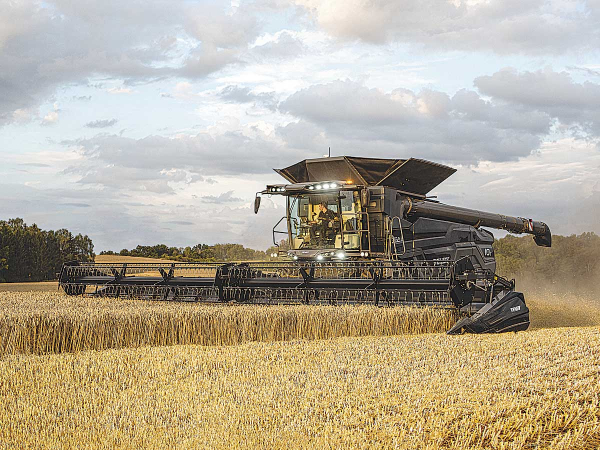
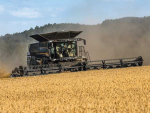
Farm machinery brand Fendt has expanded into the harvester market in Australia and New Zealand, with is Ideal combine harvester.
Built at AGCO’s European Harvesting Centre of Excellence in Breganze, Italy, the 4-model range dubbed Ideal 7, 8, 9 and 10. The machines are offered from 451 to 790 HP, the entry model utilising an AGCO Power engine, while the three larger units feature high-output MAN power plants.
Ideal uses the Helix threshing unit and separation system. This utilises single (Ideal 7) and twin longitudinal rotors (8, 9 and 10) of 4.84m long and 600mm diameter. To handle the crop gently, yet ensure constant load on the rotors, intake augers, threshing bars and rotor fingers are arranged in a spiral around the rotors, like the typical DNA chain – hence the name Helix.
With twin grain pans deal at the front of the threshing area, a rear grain pan only deals with material from the separation area, meaning the total area is fully utilised. The curve of the grain pans means the machines can maintain consistent output on slopes of up to 15%.
The Ciclone cleaning system is designed to increase cleaning capacity, particularly on the Ideal 10, with a 4-channel system. Meanwhile, the curved, double cascade steps of the WavePan provide a wider area and more air flow.
Automation of the threshing and cleaning elements uses Mass Acoustic Detection sensors (MADS) in the rotor and shaker shoe. This detects crop flow and operating capacity.
In combination with grain quality cameras, to allow accurate monitoring of grain losses, cracked grains and sample quality, the driver can adjust the ratio between output and quality, depending on the circumstances.
Designed to carry headers of up to 12.2 metres (40-feet) the grain tank capacity tops out at 17,100 litres, with a discharge rate of 210l/second. This is said to be 15% greater than its nearest competitor.
A narrow frame width of just 1400mm allows space for large tyre equipment or tracks, keeping transport widths within 3.3 or 3.5 metres, respectively. In the case of 26-inch wide tracks, the contact patch is around 2.55 square metres, helping to reduce ground compaction
For quick shifts between paddocks, the AutoDock header system allows automated docking of hydraulics and electrics within five seconds. Meanwhile, RFID coding recognises the attachment and retrieves all the previous settings for the header control.
Inside the cabin, alongside all the main creature comforts seen in modern harvesters, such as suspended seat and climate control, the Ideal lacks one familiar control-the steering wheel. This is replaced by a speed sensitive joystick integrated into the left- hand armrest. This gives unhindered visibility to the full width of the cutter-bar and reduced driver effort.
“The Fendt IDEAL is a high capacity and technology led combine that aligns perfectly with Fendt’s positioning in the professional broad-acre sector,” says Jake Kerr, product marketing manager for harvesting at AGCO. “We’re very excited to be offering the harvester into the ANZ region.”
Minor Covid impact
Although Covid-19 has caused major problems in the agricultural machinery sector, German manufacturer Fendt looks to be on target to produce 18,700 tractors in 2020.
The company recently confirmed that although it expected to fall a little short of its 20,000-unit target and the number will be slightly less than the 18,940 result in 2019, it will be a good result.
Company spokesman Christoph Goblinghoff said that while tractor markets such as Germany, Switzerland, Sweden, Sweden, Austria and Poland were holding or increasing sales compared to last year, others such as France, Italy, UK and Spain were showing double-digit declines.
Overall, it is expected that the European market will be down by around 6% from the 171,000 total units delivered in 2019. Looking at Fendt’s 2020 production, 16,700 will be delivered into the European market, representing a 10.5% share of the total.
In its home country of Germany, the Marktoberdorf factory has achieved a market share of 28.4% in tractors over 51hp, which climbs to a 40.1% market share of the over 200hp sector.
www.fendt.com