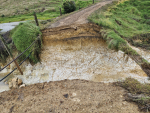
Award-winning Māori farm severely damaged by isolated Northland thunderstorm
One of the country's top Māori farms has been badly damaged by a severe isolated thunderstorm which hit parts of the east coast of Northland last week.




 increase font size
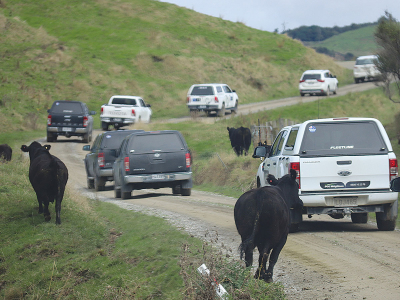 A 250-strong crowd turned up to the Whangara Farm field day earlier this month.
“The huge turnout to our field day has blown me away.”
That’s the response of the chair of Whangara Farm, Ingrid Collins, to the 250-strong crowd that came to see their property, a finalist in this year’s Ahuwhenua Trophy for the top Māori sheep and beef farm.
Whangara Farms is 8500ha (6900 effective) 35km north of Gisborne, running 45,000 sheep and 6000 cattle and employing 17 full time staff. Whangara Farms is a partnership of three Māori incorporations – Whangara B5, Pakarae A and Tapuwae Whitiwhiti — meaning three major incorporations of Ngāti Konohi are under one management system.
Field day visitors were welcomed at the local marae located 100m from the beautiful East Coast beach where the movie Whale Rider was filmed.
After the welcome, a convoy of 4WD vehicles took guests on a tour of some key parts of the farm where they saw prize Angus cows and the farm’s Romney sheep. Lambing percentage on the farm is 145%; calving of mixed age cows is 94%.
By a special radio system the farm manager, Richard Scholefield, broadcast a commentary from his vehicle, heard by visitors in their vehicles. At two stops Scholefield and other staff talked about various aspects of the farm and their goals which include producing a ewe flock that is facial eczema tolerant and whose wool is higher quality.
The visitors saw the farm’s flats and steep hill country, getting spectacular views of hills and coast.
Later, Scholefield and other staff gave formal presentations about the farm in a hall near the marae and took questions.
Ingrid Collins, chair of the farms for 13 years, expressed amazement that so many turned out.
“I didn’t think we would get so many people here,” she told Rural News. “When we had our own field day in February we had 164 turn up. We had said we may get 200, but there were easily that and more today.”
Collins is proud of the three Māori incorporations’ cooperation in forming Whangara Farms. She said it isn’t always easy to get Māori to work so well together. The farm board has a representative from each incorporation and two independent directors.
“The reason we only have two independent directors is so that we are never overruled by the independent people,” she says.
Collins assured the field day attendees that Maori can be very successful in a regular farming operation.
She is full of praise for manager Richard Scholefield whom she says has done a wonderful job on the farm and has embraced all the key Māori values.
“We can show here that this is not only a good Māori farm, but that it equals or is better than any other farm in the country,” she says.
The Whangara Farms field day is the first of three running in the next three weeks.
Similar events are running on the other two finalists’ farms: Te Awahohonu Forest Trust’s Gwavas Station, at Tikokino, 50km west of Hastings; and Eugene & Pania King’s Kiriroa Station, at Motu, 70km northwest of Gisborne.
The winner of the competition will be announced at an awards night in Gisborne on Friday May 24.
One of the country's top Māori farms has been badly damaged by a severe isolated thunderstorm which hit parts of the east coast of Northland last week.

Coby Warmington, 29, a farm manager at Waima Topu Beef near Hokianga was named at the winner of the 2025 Ahuwhenua Young Maori Farmer Award for sheep and beef.
Recently two of New Zealand's top Maori sheep and beef farms held field days as part of the prestigious Ahuwhenua Trophy competition. The two are: Whangaroa Ngaiotonga Trust, northeast of Whangarei, and the proprietors of Tawapata Onenui farm on Mahia Peninsula in southern Hawke's Bay. Reporter Peter Burke attended both field days.
Farms from Northland and northern Hawke's Bay are the finalists in this year's Ahuwhenua Trophy competition for the top Māori sheep and beef farms.
The search is on to find the top Māori sheep and beef farm with entries now open for the 2025 Ahuwhenua Trophy competition.


Fonterra shareholders can begin voting on Tuesday 20 October in the 2026 Board of Directors’ election, a Co-operative Council election in one Ward, and seven Annual Meeting resolutions.
National’s pledge to introduce 19 new national standards shows the party is serious about getting Wellington out of farming, Federated Farmers says.
The National Party’s policies to make it easier to grow fresh vegetables, secure reliable water and energy and simplify farm planning are practical changes that will give growers the confidence to invest, according to Horticulture New Zealand (HortNZ).
Fonterra Co-operative Group chief financial officer Andrew Murray has resigned to take up a role outside the dairy giant.
A major move is about to get underway to improve the quality and viability of dairy beef and cattle in NZ.
Veterinarians say changes to the code of welfare for dairy cattle provides a positive foundation for improved cattle welfare across the country.




OPINION: The same mainstream media muppets that brought you Jacindamania in 2017 have been flat out pimping for the Opportunities…
OPINION: Your old mate reckons the atrocious way farmers in the UK are treated by their lords and masters in…




