Pichon Adds SV10R and SV14 to SV Slurry Tanker Range
French manufacturer Pichon has expanded its SV slurry tanker range with the launch of two new models.
 increase font size
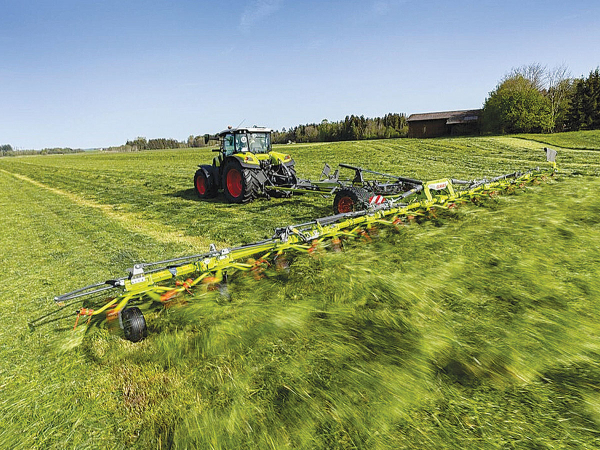 The Claas 15m Tedder allows it to cope with changing ground contours.
Over the last two decades, the days of combi machines for spreading and raking grass have disappeared, with manufacturers and end users realising that dedicated machines lead to far better results.
Claas was one of the first to offer a harvesting system where mowers were matched with tedders, that in turn were followed by recommended swathers, to present the best possible row to the harvesting elements.
Produced at its Bad Saulgau facility, the latest Claas tedder range has been “topped off” with the Volto 1300 and 1500 models, each unit offered with the choice of non-steered or steered axles.
In the case of the 1500 model, which is equipped with fourteen rotors, each 1.5 metres diameter, the stresses placed on the machine chassis and sub-frames, in both sizes, have resulted in a completely re-engineered solution, alongside a new driveline.
The result is said to provide increased strength and durability, but also allows the machines to cope with the changing ground contours that are likely to be simultaneously encountered, both longitudinally and laterally, across the fully working width.
Clever geometry ensures the centre of gravity of the re-engineered frame remains close to the transport axle, ensuring maximum stability, particularly when lifting at the headlands. The steering axle option also comes into play on the headlands, allowing the rotors to stay in work and make the operation smoother.
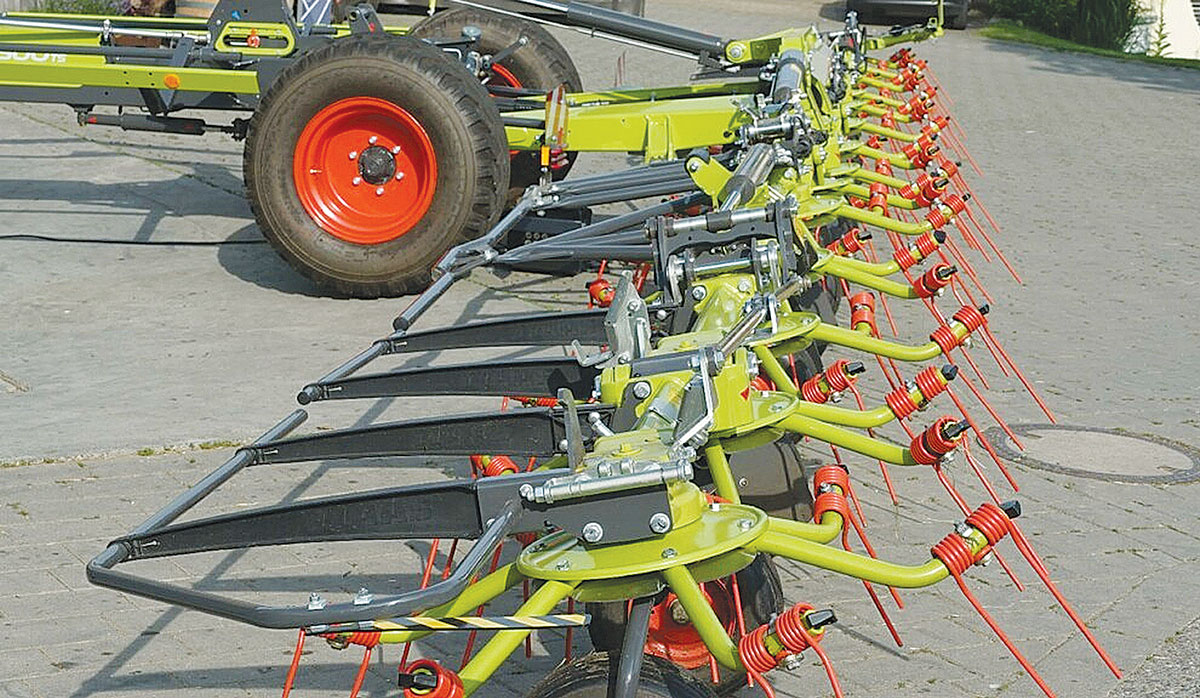
Looking at the machine in more detail, the tedder rotors remain the company’s well known Max Spread units with arms angled at a very precise 29.3°.
 |
|---|
|
The 1500 model, which is equipped with fourteen rotors. |
The overall machine rake angle is adjusted by a single crank handle situated at the front of the main chassis, with the inclusion a large position indicator for easy adjustment. The angle of engagement can be adjusted between 12-16˚. The rotor houses are now oil filled to increase longevity and reduce service intervals.
Looking at the driveline, the shaft speed has been increased by 50% to reduce the torque loadings, while the finger drives, connecting each part of the frame, have also been reinforced to allow 180° folding, even at full power.
Moving the tedder from work to transport is achieved using a single- acting lift ram, with a double-acting spool valve controlling the folding of the two arms and lowering into the carrying cradles. Overall transport width is kept below 3m with a folded height of 3.29m.
In the case of the 13m version, the machine is configured with 12 rotors, although the driveline remains the same as its larger brother, as does the choice between either 15/70-18 or 500/55-20 tyres for softer conditions.
French manufacturer Pichon has expanded its SV slurry tanker range with the launch of two new models.
Recently revealed, Krone’s new Series Six, BiG Pack Plus and Pro balers are designed to use standardised components, interfaces, and control concepts, including pick-up, knotter systems and user interfaces.
Consuming around six years and more than 35,000 hours of physical and digital testing, the new sixth-generation Valtra T Series is being described as the most significant new release in the company’s history.
Strautmann has introduced a new Hay Edition auger for its Verti-Mix feed mixer wagons, aimed at operators using rations with larger proportions of hay or other long-fibre materials.
At a time when many businesses are taking a cautious investment approach, Landpower continues to back its customers, having officially opened the doors to its new CLAAS Harvest Centre dealership in Feilding, marking a significant investment in the future of agriculture across the lower North Island.


National’s pledge to introduce 19 new national standards shows the party is serious about getting Wellington out of farming, Federated Farmers says.
The National Party’s policies to make it easier to grow fresh vegetables, secure reliable water and energy and simplify farm planning are practical changes that will give growers the confidence to invest, according to Horticulture New Zealand (HortNZ).
Fonterra Co-operative Group chief financial officer Andrew Murray has resigned to take up a role outside the dairy giant.
A major move is about to get underway to improve the quality and viability of dairy beef and cattle in NZ.
Veterinarians say changes to the code of welfare for dairy cattle provides a positive foundation for improved cattle welfare across the country.
Today, 15 October, is the International Day of Rural Women, which recognises rural women’s contribution to farming, communities and the environment.