DairyBase and MINDA Link Up to Cut Farmer Paperwork
Farmers can spend less time on paperwork, thanks to a new data sharing agreement between DairyNZ’s DairyBase and LIC’s MINDA software.
 increase font size
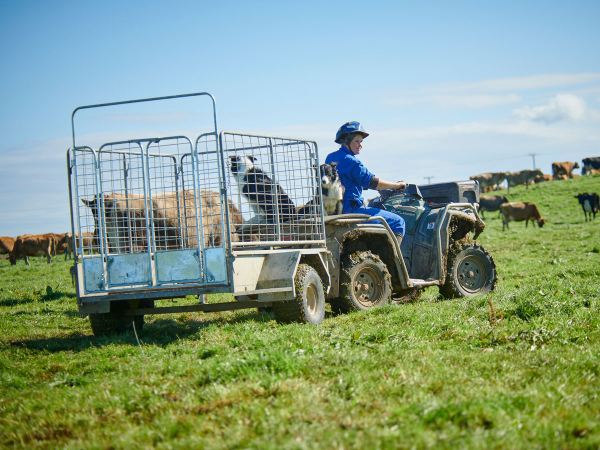 The Easy-Entry Calf Trailer Gate being towed on farm.
As calving season approaches, so too does the increased risk of sprain and strain injuries for dairy farmers.
However, scientists and farmers have joined forces to find ways of avoiding these common injuries during spring, to help farmers keep farming when they are at their busiest.
DairyNZ’s three-year Reducing Sprains and Strains project set out to understand the common causes of injuries and work with farmers to develop practical solutions to reduce them on New Zealand dairy farms.
Dr Callum Eastwood, DairyNZ senior scientist, says the overall aim was to reduce lost time and productivity and support farmers’ wellbeing, especially during calving.
The physical nature of farming means that even when health and safety is prioritised, preventable sprains and strains can still happen.
In 2022 and 2023, there were approximately 1,500 claims, totaling $5-6 million to ACC each year.
Most injuries were to the back, often from calf-related activities, including lifting heavy objects like calves, buckets, or bags of meal.
“Research has shown that sprain and strain injuries make up around 40% of dairy farm injuries, with the highest risk period during the spring calving season,” says Eastwood.
“We were focused on working directly with farmers, every step of the way, to understand the issues, and together innovate, design, test and refine product designs that were easy to use and worked for current farming practices,” he says.
“Our workshops involved farm owners, employees, health and safety experts, engineers and other professionals with insights and experiences to help develop solutions that reduce risks around essential tasks.”
Following the initial designs, DairyNZ has worked with manufacturers to help develop and produce some of the successful solutions. This includes Kea Trailers who are now selling the popular Easy-Entry Calf Trailer Gate, and Gallagher who are taking expressions of interest for the Easy-Access Calf Pen Gate.
Eastwood says the successful workshop concepts were built into physical prototypes with the manufacturers, and then tested and refined based on farmer feedback.
“It includes the calf trailer gate, which was intensively tested by farmers last calving season, then refined to ensure it is farm ready,” he says.
“New Zealand has many different farm types and so the solutions aren’t a one-size-fits-all. However, the project’s co-design approach, with farmer testing, feedback and refinement, meant the creation of tangible options for farmers to reduce these injuries on-farm.”
The project was funded by ACC’s Workplace Injury Prevention Grants programme, with co-investment from DairyNZ.
Farmers can spend less time on paperwork, thanks to a new data sharing agreement between DairyNZ’s DairyBase and LIC’s MINDA software.
OPINION: In the 1980s, concern was expressed in West Germany about the falling birth rate. Some simple analysis was performed by Professor Helmut Sies, physician and biochemist at Dusseldorf University. His letter ‘A new parameter for sex education’ was published in Nature in 1988:
OPINION: Dairy farmers know better than anyone that change is constant.
A four year trial has reaffirmed that mixing plantain into dairy pastures can help reduce nitrogen losses to freshwater while maintaining milk production and profitability, say researchers.
OPINION: Today marks Farm Worker Appreciation Day – a day we’re proud to recognise here in New Zealand.



OPINION: In politics, credibility is and should be big. It must surely rank higher than charisma, which is quite trite and superficial. Yet, voters nowadays are often wooed and influenced by how someone looks or talks at a superficial level. TV plays a huge role in this.

Farmers can spend less time on paperwork, thanks to a new data sharing agreement between DairyNZ’s DairyBase and LIC’s MINDA software.
Kaikōura families affected by July's severe storm have found a practical solution to a problem that's kept some children away from regular schooling for weeks: a washed-out section of Inland Kaikōura Road, which has stopped the local school bus from running its usual route.
Rural New Zealand is welcoming the Government’s recent package of rural healthcare initiatives.
Interest in agritech and production animal systems has prompted Massey University's School of Agriculture and the Environment to new majors to its popular animal science degree.
Ballance Agrinutrients chief executive Kelvin Wickham says despite a tough year, he is pleased the business has returned to profit.