Case IH Unveils Next Generation Puma Series Tractors
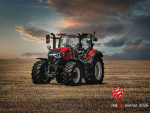
Case IH has unveiled its redesigned next generation Puma Series tractors, said to offer improvements in connectivity, operator comfort, fuel efficiency and drivability.
 increase font size
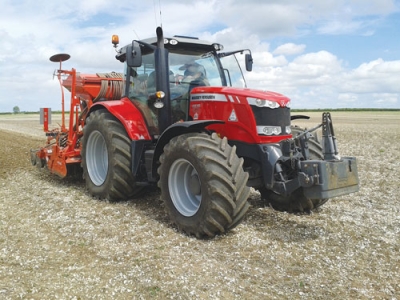
Shallower Ruts and less soil compaction came to light in a field test of Michelin XeoBib tractor tyres.
The tyres featured the maker’s Ultraflex technology, reports the New Zealand distributor, TRS Tyre & Wheel.
The XeoBib tyres were fitted to a Massey Ferguson 6616 tractor/ Kuhn power harrow drill combination in a 100ha field.
With conventional tyre pressures (20 psi front and 30 psi rear) it cost the NZ equivalent of $1932 in fuel to drill the field, and resulted in an average rut depth of 133mm. But when the pressures were dropped to 7 psi front and 13 psi rear the cost was just $1142, saving $790. The average rut depth was 88mm, and soil compaction was markedly lower.
Michelin’s agriculture technical manager, Gordon Brookes, commented, “The benefits of Michelin’s Ultraflex technology lie in its ability to be run at incredibly low pressures. This not only has multiple paybacks for the soil, notably reducing compaction and therefore enhancing yields, but the enhanced traction also means the wheels don’t slip as much, so don’t use as much fuel to complete the job.”
As well as Xeobib and Axiobib tractor tyres, Michelin has Ultraflex tyres for other applications – CargoXBib high flotation tyres for trailers, CereXBibs for combines and forage harvesters and SprayBibs for high-clearance sprayers.
Tel. 0800 336 334
Case IH has unveiled its redesigned next generation Puma Series tractors, said to offer improvements in connectivity, operator comfort, fuel efficiency and drivability.
Continental was founded in 1871, offering solutions for vehicles, machines, traffic and transportation.
A total of 108,800 tractors were registered across Europe in the first six months of 2022, with 31,900 tractors of 37kW (50 hp) and under and 76,900 of 38kW and above.
Alliance, a part of Yokohama Off-Highway Tyres, has introduced a new tyre, especially designed for pivot irrigation systems.
Choosing the right new vineyard tractor is an important decision, given the major capital outlay.



Now in its fourth year, the 2026 Fencing Industry Awards, formed part of the proceedings of the FCANZ Conference, held in Nelson during August.

DairyNZ deputy chair Cameron Henderson has been re-appointed unopposed for another term.
OPINION: The stats speak for themselves.
Farms across the upper North Island are trialling different pasture mixes as part of a research programme that aims to build greater resilience into farming systems.
Election years are always a concerning time for farmers, according to DairyNZ chair Tracy Brown.
The Ballance Farm Environment Awards are coming to the West Coast of the South Island.