Given that any fruit crop needs good logistics for getting ripe crops to the packhouse, efficient transport systems are a must.
The Transtak trailer range, designed as far back as the early 1990s, has evolved into a well-thought out and reliable transport solution. It encompasses all areas, with a range that starts with a 2-bin/ ATV model, right up to a 12-bin/7,000kg capacity unit for bulk transport. Testament to the excellent design detail and high build quality, is that many of these trailers supplied in the early days are still putting in a hard day’s work at harvest.
The versatility of the Transtak design has helped in the rapid expansion of the kiwifruit crop in the Bay of Plenty, which brought with it the problems of finding staff and getting picked fruit away from beneath low pergolas and into the packhouse.
This rapid expansion saw the need to integrate trailers into the operation, leading to a position of market leader and the trailer of choice in the kiwifruit industry – with dozens sold into the region every year. This popularity has been built on performance, reliability, strength and minimal maintenance requirements.
In kiwifruit, comparing the performance of the Transtak system with a conventional roller trailer system, a single 1500l or 1500LE trailer is able to keep up with 3 or 4 picking teams, compared to the need for 2 or 3 roller trailers to keep up with just one team. In fact, a single three-bin unit will do the work of 9 to 12 roller trailers.
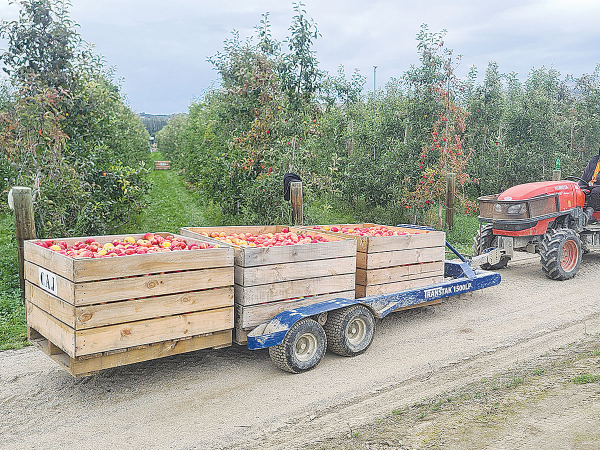
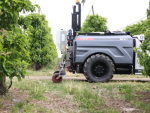
Typically mounted on the front of the tractor for ‘pushing’, the trailers are equally at home on the rear of the tractor for longer transport duties. All units are fitted with a soft-ride suspension system, ensuring bins don’t bounce during transport as they move over obstacles, thus retaining fruit quality and operator comfort.
In the apple industry, the trailers help to improve efficiency of bin movements by supporting the forklifts that work within the rows. Typically, forklifts will create stacks of 3, 6 or 12 bins at the headlands, that are taken away by the bin trailers and replaced with empties.
This helps ensure that forklifts stay near the pickers, while removing the need for long, bouncy runs to the loadout areas. The result is improved efficiency and fruit quality, and a reduction in the total amount of machines operating in each block.
Additionally, for short to medium distance runs to the packhouse, the Transtak system eliminates the need for loading bays in the orchard. This reduces truck movements and ultimately frees up more space for additional trees.
Looking at the general specification, as an example, the 1,500l trailer features a 6.00 RHS wheel frame, a 3-inch hydraulic cylinder with 350mm lift height. It has rubber load cushioning on the lifting forks that are manufactured from tapered pressformed high tensile steel. The 225-70R15 tyres are carried on 15-inch rims, which are protected by rolled steel mudguards that also incorporate deflector struts and bin lead-in rails.
An integral part of the system is the Transtak Soft-Ride rubber and hydro-pneumatic suspension system. Options include trailer light and indicators, rear-facing work lights for use under canopies or poor light conditions, as well as an easily operated parking jack.
Manufactured in two versions, the T1500l can handle 1,200mm by 1,200mm bins, while the T1500LW is designed for bins of 1,600mm by 1,100mm dimensions.
www.transtak.co.nz