James Blair Named 2026 Young Grower National Champion
James Blair, an agronomist for AS Wilcox and the Pukekohe regional champion, has won the 2026 Young Grower national title.



 increase font size
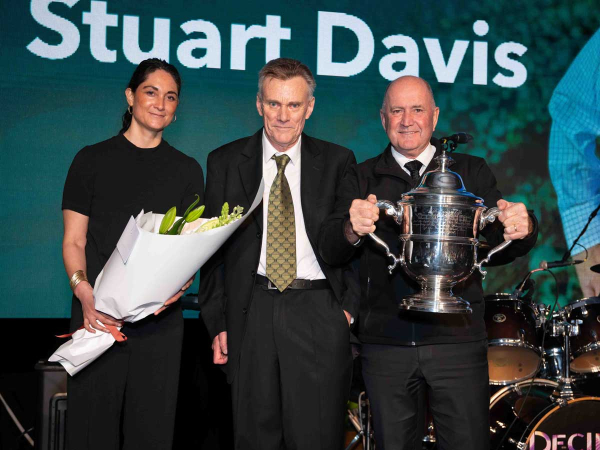 Dr Stuart Davis, centre with HortNZ board vice-chair Bernadine Guilleux and chair Barry O’Neil.
The days of being a simple vegetable grower are long gone and there is a need for highly skilled people in both the business and science side of any operation.
That's the message from Dr Stuart Davis, LeaderBrand's sustainability manager, who recently won NZ's highest horticulture honour - the Bledisloe Cup for 2024.
The Cup is awarded by Horticulture New Zealand annually in recognition of individuals who have made an outstanding and meritorious contribution to the horticulture industry in New Zealand over decades.
For more than 35 years, Davis has championed the use of science and innovation to enhance sustainable vegetable production.
It's said that there's nothing he doesn't know about growing vegetables.
Davis, 65, grew up in Pukekohe, but his folks were not involved in vegetable growing. He went to Massey University and while doing a postgraduate scholarship, developed a system of containerised transplants for vegetables - put simply, growing seeds in pots for later transplant rather than growing directly into the soil. This innovation was quickly taken up by tomato growers in Gisborne.
"They started doing this even before I completed my studies," he told Hort News.
For about half his career he worked for Watties, where he applied science to such things as crop scheduling. In 2002, he joined LeaderBrand and was almost immediately involved in developing an integrated pest management programme - at that stage, to deal with a lettuce aphid problem.
Davis has been a director of Vegetables NZ and chair of the Vegetable Research and Innovation Board and is currently the Industry Stakeholder Advisory Group Chair for A Lighter Touch.
Much has changed since Davis began his career in the late 1970s.
He says in the early days it was unheard of for a grower to have a science-type person involved in their business.
"These days virtually all vegetable growing operations employ an agronomist - even medium sized operations either someone in the family with these qualifications or have a trained agronomist on staff," he says.
As for the future, Davis says he has no plans to retire and will continue to work because he loves the job.
James Blair, an agronomist for AS Wilcox and the Pukekohe regional champion, has won the 2026 Young Grower national title.

Horticulture New Zealand says proposed changes to the Plant Variety Rights Act 2022 will drive innovation, investment and long-term productivity.
Major New Zealand fresh produce grower is tapping AI to manage weeds on one of its farms.
A pillar of New Zealand's horticultural industry, Dr Stuart Davis, was farewelled at a well-attended funeral service in Tuakau, South Auckland, on December 18.
Spinach is NZ's favourite leafy green, according to the Department of Statistics.


Federated Farmers has welcomed new rural policies released by ACT, saying they align closely with its own election priorities.

Rural Contractors NZ says proposed changes to land transport rules for agricultural vehicles are a welcome response by the Government to out of date regulations which have seen members hit with huge fines.
Alliance is calling for final applications for its 2027 Graduate Programme, with applications closing on Sunday 25 October.
Decades piloting planes has ensured vet and farmer David Hayes is focused on safety. So, after a serious accident while welding on farm, he is sharing his experience so others can learn from it.
Canterbury milk processor, Synlait Milk has confirmed Leon Fung as its chief executive officer.
OPINION: Making it easier to collect rainwater and use it to grow crops and livestock is a no brainer.

OPINION: The same mainstream media muppets that brought you Jacindamania in 2017 have been flat out pimping for the Opportunities…
OPINION: Your old mate reckons the atrocious way farmers in the UK are treated by their lords and masters in…




