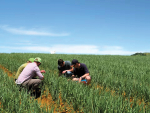
Keep What Works Working: NZ's New Resistance Campaign
New Zealand growers have always adapted to changing conditions, but one challenge is steadily gaining ground across the horticulture sector: resistance.



 increase font size
 Recent flooding in the Pukekohe area has added to pressures to get early onion export shipments away on time.
The recent wet weather in the Pukekohe area has added to pressures to get early onion export shipments away on time.
"We have a finite window for Europe which makes up 40% of exports so that's quite important," James Kuperus, chief executive of Onions New Zealand, told Hort News.
The first shipment was able to be sent in the first week of February with the focus now shifting to supplying the Spanish market.
"It will be tight but not impossible."
While Hawke's Bay has had a difficult season, crops grown in the Manawatu and Canterbury were looking good for the peak of the export season which runs until May, counter to European production.
"It's all about managing the quality and expectations of what will be coming out of Pukekohe."
It was too early to tell what the total damage to crops in the area was. Some of the flooding had been superficial but had added to quality concerns in what had already been a very wet season.
Kuperus says growers were aware of which of their onion blocks might be of lesser quality so woud be working with exporters to send class two products to other export markets, which didn't pay a premium for top quality, or for local processing.
The final returns for the season wouldn't be known until September. In recent years, onion exports have sat around a value of $150 million annually with the crop, grown on over 2,000 hectares, mainly exported to Europe and Indonesia.
New Zealand growers have always adapted to changing conditions, but one challenge is steadily gaining ground across the horticulture sector: resistance.

Exporters need to understand that India should not be seen as just one country to export to, rather a country of many unique states and regions.
Onion exports to the lucrative Indonesian market are resuming after officials negotiated an end to costly pre-export methyl bromide fumigation.
Some smart planning by NZ’s onion growers has enabled them to quickly cash in on the Free Trade Agreement between New Zealand and the European Union which came into effect on May 1.
NZ onion growers are getting an extra $3 million this season for exports to the European Union, thanks to the early ratification of a free trade agreement (FTA).



Farmers are being encouraged to rethink how they manage waste on farm with the launch of ruralwastesorted.co.nz, a new website bringing together practical tips, real farmer experiences and resources.

New Zealand Winegrowers (NZW) is celebrating the India-New Zealand Free Trade Agreement (FTA) coming into force today, bringing New Zealand wine improved access to one of the world’s fastest-growing economies.
New Zealand’s red meat sector has welcomed the India-New Zealand Free Trade Agreement taking effect, which removes India’s 33% tariff on New Zealand sheepmeat.
More than 95 per cent of New Zealand’s forestry and wood exports to India can now enter tariff free as the New Zealand-India Free Trade Agreement comes into force today.
Federated Farmers is backing Feilding High School’s call to keep Agriculture and Horticultural Science as a standalone subject in Year 11.
Food and fibre exports have returned a billion- dollar bonus to the country.


OPINION: The same mainstream media muppets that brought you Jacindamania in 2017 have been flat out pimping for the Opportunities…
OPINION: Your old mate reckons the atrocious way farmers in the UK are treated by their lords and masters in…




