Breeding Ewe Hoggets: Key tips for maximising lamb survival and farm profitability
With lamb prices at record highs, many farmers are considering breeding their ewe hoggets for the first time.
 increase font size

THE KEY issue with in-lamb hoggets is making sure they continue to grow and ensure that the animal has sufficient feed to allow for the foetus to grow as well, says a leading researcher on the subject.
Massey University’s Prof Paul Kenyon says this means if farmers want the young hogget to gain 10kg of her own weight in pregnancy, plus the 10-12kg of pregnancy itself (foetus plus fluids), she needs to put on about 130-140g/day.
That’s different to in a mature ewe where for the first two thirds of pregnancy maintenance feed is all that’s required and you feed for the sudden growth of the foetus in the last trimester.
“In a young hogget you can’t afford to do that,” stresses Kenyon.
“In the first two thirds of pregnancy you have to make sure that she grows and that you give her a good level of feeding and remember it will go to her and not to the foetus. Then in that last third those high levels of feeding will go to the foetus because that’s the way she physiologically switches. In late pregnancy, the mother always gives to the foetus.”
If you don’t grow her on the first two thirds of pregnancy, and just feed well in late pregnancy, what happens it all goes to the foetus, which grows to almost normal size in a mother that hasn’t grown, often resulting in birthing difficulties and a reduced chance of lamb, and indeed hogget, survival.
Lambs and hoggets that do survive will be lighter at weaning.
Kenyon says success with lambing hoggets starts before mating: get liveweights well up, then use harnesses on rams to identify animals tupped, and follow up with scanning to be sure which ones are pregnant. Those that aren’t can go on a traditional hogget management regime; those that are need to looked after from the outset.
One of the myths that needs busting with pregnant hoggets is that because they have a lower liveweight than ewes, they can be fed less. Grow a crop or bring in extra feed to ensure they can be well fed, suggests Kenyon. Either that, or reduce numbers in other stock classes to increase feed availability.
But when it comes to lambing hoggets, Kenyon says the same rules apply to them as to mature sheep.
“You should try to pick out sheltered paddocks, put multiples at lower stocking rates than singletons and hopefully not have the covers going below 1200 kgs/DM which is about 4cm sward height.
“Those are things you do which don’t differ from what you do for a mature ewe. The only thing I would say is that some people who are very successful lamb their hoggets on to Lucerne, chicory or plantain. The evidence is that when you do that you get even higher performance than even a very good rye grass white clover.”
If hoggets are struggling a bit after lambing consider weaning two or three weeks earlier, he adds.
“While you might forego a bit of value on that lamb, you are actually giving her more time to recover because she won’t be lactating so long…. You will ensure that she’s a good two-tooth and you want her in your flock for the next four years. It’s a case of a bit of short term pain for a bit of long term gain.”
• Farmer perspective: p38
With lamb prices at record highs, many farmers are considering breeding their ewe hoggets for the first time.
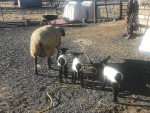
A Christchurch manufacturer of woollen covers for newborn lambs says his covers pay dividends in survival rates and liveweight gains, especially at a time when farmers are feeling the economic pinch.
Should twins born to ewe hoggets and grown out to heavy weights be retained as replacements and mated as ewe lambs?
The ideal weaning date should be guided by whether it achieves two key goals.
Hogget breeding has the potential to improve farm productivity but they take careful management according to Professor Paul Kenyon of Massey University. Peter Burke reports.


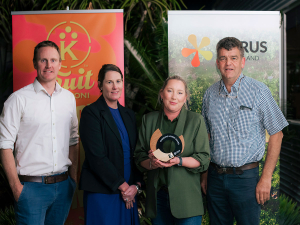
New Zealand's citrus growers were challenged to build their future on the value embedded in their fruit rather than the volume they produce, at Citrus New Zealand's annual gathering in Gisborne on 17 September.
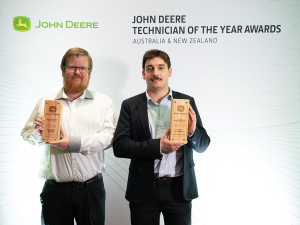
Leading John Deere technicians and apprentices from New Zealand and Australians were recognised at the recent sixth annual JD Technician of the Year Awards, held in Brisbane.
In Dacre, near Invercargill in New Zealand’s South Island, Bruce Dinnington is running a dairy operation unlike any other.
A free online platform aggregating governance vacancies across rural and regional New Zealand has been launched.
Environment Minister Nicola Grigg has announced details of a new rural plastics recycling scheme.
Agricultural drone operators say that a government decision to allow lower-risk drone work without certification won’t lower standards but drive innovation and efficiency.