Krone XDisc 710 Now Fits John Deere, New Holland Foragers
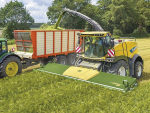
Krone's XDisc 710 direct-cut header can now be used by John Deere and New Holland forage harvesters, as well as the Krone Big X it was originally designed for.
 increase font size
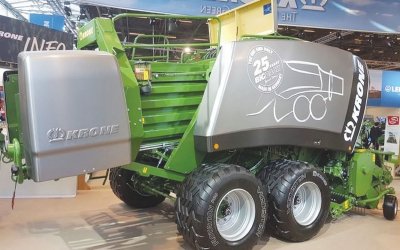 Krone Big Pack baler.
While the German manufacturer Krone can claim a history dating back 115 years, its large square balers are much more recent.
In 2018 it celebrated 25 years since launching its Big Pack baler, and has since gone for a range of different bale sizes — 19 different models to suit applications worldwide.
When it launched the Big Pack in 1993, the machine brought with it several innovations that today are used by many of its competitors.
Items like tandem axles have become the norm for bigger machines, and a chopper unit, back then with only three blades, has become a must-have for many contractors.
Likewise, the overload system on the Big Pack’s packer system moved away from a more typical shear bolt set-up to a clutch assembly that took the unit back to its previous position.
Along the way, Krone introduced its Variable Fill System (VFS) in 1999 -- four packers and a feeder fork, with the latter also doubling as a packer until the bale chamber is full.
The Krone Multi-Bale was claimed in 2003 to be the first baler of its kind, enabling users to make one large bale or up to nine smaller bales that can be bound into one bundle for easy handling. This proved popular with those looking to feed small groups, individual animals or stock in pens or stables.
The High-Density Press (HDP) arrived in 2005, reported to pack 25% more into a bale than its standard counterpart.
And in the same vein, 2007 saw the arrival of the Pre Chop, a front chopper unit that ‘guaranteed’ uniform chop lengths while also fragmenting the material being loaded.
In 2011, the Big Pack High Speed was claimed to deliver 20% higher throughput than the previous model, while maintaining density. And in 2013, the HDP 2 also brought increases to throughput and density.
Krone's XDisc 710 direct-cut header can now be used by John Deere and New Holland forage harvesters, as well as the Krone Big X it was originally designed for.
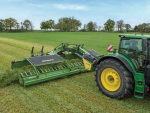
Already known for its extensive range of mowers, tedders and swathers, German manufacture Krone looks to be joining the trend in the swather sector, following the release of its first belt merger, the Swativo T1040 Pro.
While turnover was back slightly at €2.3 billion in 2024/2025 (previous year €2.4 billion), the German Krone Group saw earnings fall from €107 million to €40.1 million.
Ashburton-based Carrfields has announced that, from the New Year, it is officially authorised to sell Krone Forager Harvesters and Kubota Tractors across the Southland and Otago regions it represents.
Recently named Farm Machine of the Year 2026 in the forage and harvesting category at Agritechnica in Hanover, Germany, the arrival of the Krone BiG Pack HDP II 1290 Gen 6, is being touted as a major leap forward in baling technology for New Zealand farmers and contractors.


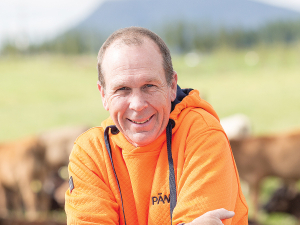
Pāmu has released its FY26 Integrated Annual Report, reporting a Net Operating Profit of $113 million, more than double the $49 million recorded in FY25.

Meat Industry Association data, released alongside the Red Meat Sector conference in Wellington, shows export value climbing across the US, China, UK and Canada.
Applications are set to open for the 2027 Zanda McDonald Award, a trans-Tasman award recognised for identifying and fast-tracking talented young leaders in agriculture and agribusiness.
The Royal New Zealand College of General Practitioners (the College) and Hauora Taiwhenua Rural Health Network are calling for investment in a proposed new training pathway for rural GPs, warning that many rural practices are struggling to recruit while a large share of the existing workforce nears retirement.
Federated Farmers has called on Central Otago District Council (CODC) to drop or vote down a plan to truck sludge from Alexandra and Cromwell to farmland near Lauder, warning it would compound an "outrageous" situation created by a separate council's decision weeks earlier.
Synlait has swung to second-half profit as operations stabilise, but the dairy processor still posted a $75.4m annual loss.