Massey Uses Portable Analyser to Measure Pasture Soil GHGs
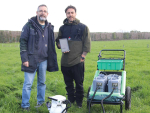
Researchers at Massey University are using a special piece of scientific equipment to improve the measurement of greenhouse gas emissions from pasture soils.
 increase font size
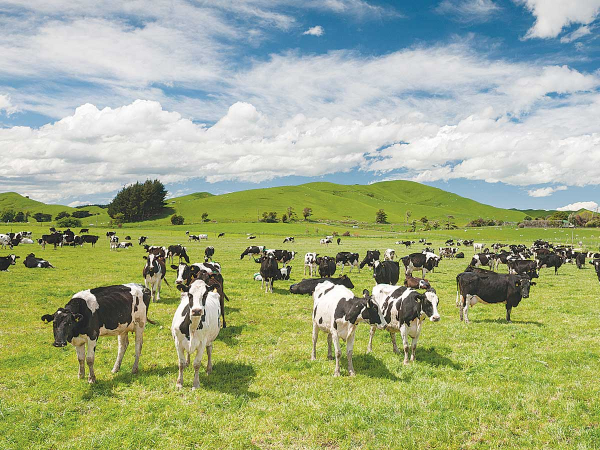 The Methane Science Accord is backed by a number of prominent farmers and others.
A recently formed pressure group is upping its campaign against any implementation of a methane tax.
The Methane Science Accord is backed by a number of prominent farmers and others. The group's backers includes the likes of Jane Smith, Hamish Carswell, Derek Daniell, Helen Mandeno, Hamish de Lautour, Deborah Alexander, John Sexton, Hamish Bielski, Neil Henderson and Owen Jennings. The group says it has been joined by hundreds of other farmers and is 'independent of but supported by' organisations such as Groundswell, FARM, 50 Shades of Green and the Rural Advocacy Group. It is asking more farmers to join the cause.
The accord says it is cranking up a campaign to help convince both rural and urban New Zealanders that taxing methane is 'unscientific, unjustified and economic insanity'.
"The most recent science is clear. Ruminant methane - our sheep and cattle burps - should not be taxed," it says. "It is too insignificant and trivial to be properly measured."
The group adds that the outgoing government and other political parties have been threatening action based on false science. They want to update them and save rural communities.
"Government and agricultural industry modelling showed that 20% of sheep and beef production will be lost - along with 5% of dairy output. That hurts farmers, their families, their communities. Our country cannot afford that cost."
The group says a tax on methane could cost the average farmer over $100,000 depending on the carbon price. "Why pay when they cannot tell you how much warming your farm is producing?"
It describes moves to implement a methane tax a "political sop" and that is not scientifically justified.
"The most recent, unrefuted science is clear - methane's ability to warm is too inconsequential to measure or be taxed."
The accord says claims that international customers will take action if we don't pay for our methane emissions should be left up to individual exporters to deal with.
"If their customers demand produce with certain condition, the exporter/processor needs to incentivise their suppliers," it says.
"Why should one company force a tax on all farmers to satisfy their consumers?"
The group also disputes claims that money paid in methane taxes will be returned to the industry.
"More than $700 million has been allocated already and is being spent on dubious pursuits. Why create an unnecessary money-go-round?"
It also takes aim at levy bodies who have supported moves to tax methane emissions, describing these organisations as out of step with farmers.
"They will have to answer to levy payers. HWEN went down a rabbit hole focused on targets instead of warming ability."
More: www.methane-accord.co.nz
Researchers at Massey University are using a special piece of scientific equipment to improve the measurement of greenhouse gas emissions from pasture soils.
OPINION: Back in April, the Intergovernmental Panel on Climate Change delivered an update that should have triggered an 8.5 magnitude earthquake in the world of climate change policy.
Centre right parties are backing policy positions pushed by three farmer lobby groups ahead of the general election.
Three farmer lobby groups are applying the blowtorch to political parties on key issues facing the primary sector ahead of the general elections.
OPINION: Among the many satisfying jobs on the farm is shifting our Angus heifers onto fresh pasture. They love it. Tails up, they gallop around for a minute, then it’s heads down — those long, raspy tongues pulling in mouthfuls of lush green feed.


Now in its fourth year, the 2026 Fencing Industry Awards, formed part of the proceedings of the FCANZ Conference, held in Nelson during August.
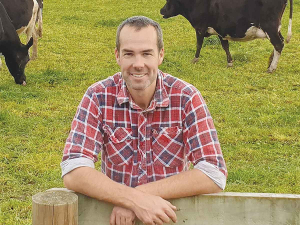
DairyNZ deputy chair Cameron Henderson has been re-appointed unopposed for another term.
OPINION: The stats speak for themselves.
Farms across the upper North Island are trialling different pasture mixes as part of a research programme that aims to build greater resilience into farming systems.
Election years are always a concerning time for farmers, according to DairyNZ chair Tracy Brown.
The Ballance Farm Environment Awards are coming to the West Coast of the South Island.