What Would Synlait Be Worth to Fonterra or a2 Milk?
Speculation of a possible joint move by Fonterra and a2 Milk to buy Synlait raises a much bigger strategic question, says agribusiness expert Dr Nic Lees.
 increase font size
 Findex Wealth Management partner Craig Smith.
A windfall of billions of dollars is good news for the agricultural sector and the economy in general, following the sale of Fonterra's global consumer businesses.
But financial services provider Findex says that farmers may not reinvest the payout quite as one might expect.
"The sale of parts of Fonterra to Lactalis for $3.845 billion raises the issue of where that capital injection to the cooperative members might be applied," says Findex Wealth Management partner Craig Smith.
"As is the case with anyone's funds, the answer varies based on individual circumstances. However, we're seeing sentiment turning away from putting that money straight back into the land that producted the payout."
The deal between Fonterra and Lactalis represents a significant financial event for Fonterra shareholders, a substantial number of whom are New Zealand dairy farmers. The transaction could potentially increase to $4.22 billion (with the inclusion of Bega lincences) and is expected to result in a tax-free capital return of $2 per shares. This dividend accrues to shareholders including around 10,000 farmers who are in line to receive a share of approximately $3.2 billion.
"That's obviously an enormous boost for farmers and regional communities," Smith notes. "For instance, a farm producing 100,000 milksolids annually could see a $200,000 payout with most farmers potentially receiving $100,000 to $1,000,000 as a capital injection."
Smith combines the capital injection with observations from the field, which indicates farmers reaching the end of their tether.
"We're seeing growing negative sentiment from dairy clients turning away from buying more land, reinvesting in their properties and doubling down into farming after a challenging decade on a number of fronts," he says.
Instead, Smith says there is an apparent appetite for other investments and a move towards diversification.
Cash, of course, provides the ultimate flexibility, and there is no shortage of options available to the “capital flush”. Strategies can include:
Where Smith’s view is firm, is that the windfall is welcomed by the nation’s rural communities. “It has unquestionably been a tough decade, so the monetary relief is palpable. Farmers now have options to leverage and improve their circumstances, and as always, the decisions ahead require close assessment of potential returns.”
Smith adds that as these discussions and decisions routinely involve the entire/wider family, they can be improved with an impartial facilitator providing financial knowledge, metrics and advice.
Speculation of a possible joint move by Fonterra and a2 Milk to buy Synlait raises a much bigger strategic question, says agribusiness expert Dr Nic Lees.

In the past, much has been made of the concept of farm to fork, but an Australian expert in food science and marketing with experience in the dairy industry, Dr Angeline Achariya, says the reverse of this slogan is critical to win modern day consumers.
A four year trial has reaffirmed that mixing plantain into dairy pastures can help reduce nitrogen losses to freshwater while maintaining milk production and profitability, say researchers.
Fonterra has opened its upgraded Chengdu Application Centre, bringing New Zealand dairy expertise closer to customers in one of China's fastest-growing regions.
Tatua chair Stephen Allen says he leaves the co-op with a deep sense of gratitude for the people who have contributed to its success.


As the cost-of-living crisis continues to put pressure on household grocery budgets, new figures show pork remains one of the most affordable fresh meat options for New Zealand families.
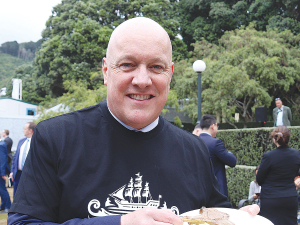
OPINION: In politics, credibility is and should be big. It must surely rank higher than charisma, which is quite trite and superficial. Yet, voters nowadays are often wooed and influenced by how someone looks or talks at a superficial level. TV plays a huge role in this.
Farmers can spend less time on paperwork, thanks to a new data sharing agreement between DairyNZ’s DairyBase and LIC’s MINDA software.
Kaikōura families affected by July's severe storm have found a practical solution to a problem that's kept some children away from regular schooling for weeks: a washed-out section of Inland Kaikōura Road, which has stopped the local school bus from running its usual route.
Rural New Zealand is welcoming the Government’s recent package of rural healthcare initiatives.
Interest in agritech and production animal systems has prompted Massey University's School of Agriculture and the Environment to new majors to its popular animal science degree.