Cyclone Gabrielle: Hawke's Bay Orchardists Still Recovering
Three and a half years on from when Cyclone Gabrielle hit Hawke's Bay, some orchardists in the region are still receiving counselling to help them deal with the trauma they suffered.
 increase font size
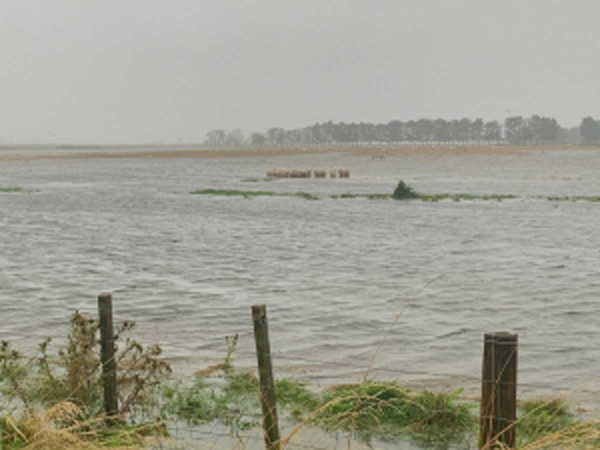 Beef + Lamb New Zealand (B+LNZ) estimates the cost for sheep and beef farmers from recent severe weather events, including two cyclones, could total between $367 million and $422 million.
Beef + Lamb New Zealand (B+LNZ) estimates the cost for sheep and beef farmers from recent severe weather events – including Cyclone Gabrielle and the Auckland Anniversary weather bomb – could total between $367 million and $422 million.
The levy group has been working with numerous groups to calculate the direct on-farm impact of the storms on sheep and beef farmers.
They claim the organisation’s report will inform the Government’s consideration of further support for farmers.
The range identified is made up of $12-16 million for Northland, $18-21 million for Waikato-Bay of Plenty-Coromandel and $336-385 million for the East Coast, Hawke’s Bay, Tararua and the Wairarapa.
B+LNZ estimates that 1,200 farms in these areas were affected and suffered damage.
B+LNZ chief executive Sam McIvor says the three severe weather events that hit the country in January and February this year – Cyclones Hale and Gabrielle and the Auckland Anniversary flooding event – will have a significant impact on both farming businesses and communities for years to come.
However, he says, those impacts are unlikely to be easily identified in industry-level statistics.
“That’s why it was so important for us to quantify the impacts and inform the Government,” McIvor says.
“As New Zealand’s biggest manufacturing sector, and second largest goods exporter, a bedrock for rural communities and a major employer, a rapid recovery of these sheep and beef businesses is vital as it impacts all New Zealanders and the economy.”
McIvor says that while farmers and growers appreciate the financial assistance already made available by the Government, considerably more is required.
“Farmers are in a critical recovery phase. The Government is looking at what that investment might look like, so they have asked for a more complete picture,” he says.
McIvor says that over 90% of the estimated impact is due to infrastructure damages since livestock losses were expected to be low at a regional or industry level. However, some individual farmers suffered high levels of livestock losses.
“The damage has primarily been to on-farm infrastructure such as fences, tracks and accessways, dams, culverts, bridges, water reticulation, and slipping, which causes revenue losses through destocking. Most of these costs are not insurable.”
He says that where infrastructure damage is significant, the impacts of the three storms can vary, both long and short-term.
“Farmers had to deal with immediate concerns such as livestock welfare but are also facing ongoing implications around land management and financial stability.
“It’s important that farmers have some certainty so they can manage through the coming months and beyond,” McIvor says. “Anything that can be done to ease the fiscal burden of, and speed up the recovery, will mean that farmers can more quickly get back to contributing to their local communities and New Zealand’s economy.”
Three and a half years on from when Cyclone Gabrielle hit Hawke's Bay, some orchardists in the region are still receiving counselling to help them deal with the trauma they suffered.
The chief executive of Apples and Pears New Zealand, Danielle Adsett, says fruit quality this year is phenomenal and the sector is hitting crop estimates, which is great for growers.
Matt McRae, a farmer from Mokoreta in Southland who runs a sheep, beef and dairy support business alongside a sheep stud, has been elected to the Beef +Lamb NZ Board as a farmer director.
Ospri is reducing TB testing frequencies and movement control measures as the disease risk subsidies in parts of the country.
Nearly three years on from Cyclone Gabrielle, Hawke's Bay apple orchardist Paul Paynter says they are still doing remedial work around their orchards and facing financial challenges.


Dairy processors are ready to further boost New Zealand’s export earnings but want the incoming government to match their ambition with good policy.
Massey University is best placed to solve the “problems” facing the dairy industry, says vice chancellor, Pierre Venter.
Synlait's longest serving employee – a man who joined the Canterbury-based milk processor even before it began processing milk – is now its newest executive.
A dairy industry leader believes eradicating the common and costly disease, Bovine Viral Diarrhoea (BVD) is within reach.
A farmgate milk price of $10/kgMS this season is firming up as milk powder prices soar and the New Zealand dollar weakens.
Federated Farmers has welcomed new rural policies released by ACT, saying they align closely with its own election priorities.