Damage to country's vegetable crops still being calculated
Local vegetable growers are in full “clean up, tidy up” mode, says Pukekohe Vegetable Growers’ Association (PVGA) president, Kirit Makan.



 increase font size
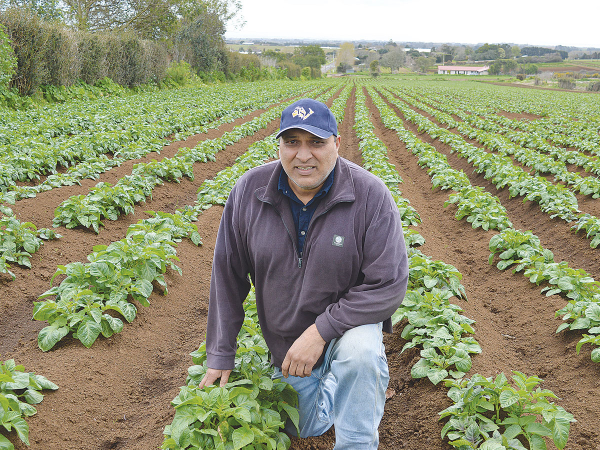 Pukekohe Vegetable Growers Association (PVGA) president Kirit Makan says compliance and regulation is making it harder for growers to continue producing fresh and healthy vegetables for New Zealanders.
New regulations and compliance issues are making it harder for growers to continue producing fresh and healthy vegetables for New Zealanders.
That's the view of new Pukekohe Vegetable Growers Association (PVGA) president Kirit Makan.
Makan told Hort News that growers are anxious. He says they are uncertain what regulations will be imposed on their farming operations around water and land use and the environment.
"We are here to produce fresh and healthy vegetables for New Zealanders and it's getting harder and harder for us," Makan explains.
The PVGA represents 180 growers - covering an area from Warkworth north of Auckland to South Waikato. Most growers are based in the Pukekohe hub - an area comprising 4,359 hectares of some of New Zealand's most fertile and productive soils.
The area's temperate, forgiving climate and proximity to essential transport routes makes it ideally located to supply year-round vegetables to Auckland and the rest of New Zealand.
However, like farmers around the country, PVGA members are also under pressure to make further improvements to farming around fertiliser usage and water quality.
Makan says like other farmers his members use fertiliser to produce marketable yield of crops. He says lowering fertiliser input would push some growers out of business.
"We just don't throw fertiliser down just for the sake of it, we need to put it down to get a marketable crop that we can sell," he adds.
"The economics of that would be I won't have a marketable crop and growing potatoes just wouldn't be viable for me."
Makan says vegetable growers, like other farmers, are keen to reduce their inputs like fertiliser.
He believes, over time, technology will come along and help growers over time reduce their fertiliser footprint.
On water supply, farmers aren't sure what the new regulations will look like.
All growers around Pukekohe have resource consents for bore and ground water takes which will need to be renewed in coming years.
Makan says while Pukekohe has been carved out of the National Policy Statement for water, there are "too many unknowns".
Local vegetable growers are in full “clean up, tidy up” mode, says Pukekohe Vegetable Growers’ Association (PVGA) president, Kirit Makan.

Pukekohe vegetable growers who had barely cleaned up damage caused in the January 27 heavy rains copped it again with Cyclone Gabrielle.
Pukekohe vegetable growers fear up to 30% crop losses in the aftermath of recent heavy rain.
Vegetable growers in South Auckland are bracing for Omicron and making contingency plans to deal with the fallout.
Pukekohe Vegetable Growers Association's (PVGA) first woman president, Kylie Faulkner, was extremely surprised and honoured to receive the President's Trophy at the recent Horticulture New Zealand Conference.


Waikato milk processor Tatua has again declared a record milk payout to farmer shareholders, leaving other processors in the dust.

A Labour-led Government won’t be bringing back the controversial freshwater rules of 2020.
National’s much-touted free trade deal with India featured in the Rural Issues Debate at Mystery Creek, Hamilton on Wednesday night.
New Zealand's 2026-27 freshwater fishing season has opened, with anglers encouraged to head to rivers and lakes over the coming days as conditions look favourable across much of the country.
Central Otago District Council (CODC) has voted against a plan to spread treated sewage sludge from Cromwell and Alexandra on farmland near Lauder, a decision Federated Farmers says reflects strong opposition from rural residents.
Pāmu has released its FY26 Integrated Annual Report, reporting a Net Operating Profit of $113 million, more than double the $49 million recorded in FY25.


OPINION: The same mainstream media muppets that brought you Jacindamania in 2017 have been flat out pimping for the Opportunities…
OPINION: Your old mate reckons the atrocious way farmers in the UK are treated by their lords and masters in…