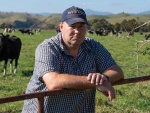
Federated Farmers dairy chairman Andrew Hoggard stepped down at last week’s annual conference after three years in the role. Here are excerpts from his final speech.
As my three years being your dairy industry chair comes to end, it is worth reflecting on what a rollercoaster ride the last three years have been for me.
For the first two years the focus was mainly on the downturn in prices, and the various attacks on the dairy industry came a close second.
During this last year, thankfully with prices recovering, the critics of dairy in particular and agriculture in general have really cranked things up.
The pressure isn’t just happening here in New Zealand, but is universal in the developed world; at the recent international dairy federation meeting we spent a lot of time on the anti-dairy movement.
The nuances are different in each country, but by and large it revolves around animal welfare and the environment.
Often the two are linked, with the vegans pushing the animal rights side, and pointing to the co-benefit of saving the planet by going vegan
Likewise, the environmentalists will point out that we don’t need animal agriculture anyway, as you can get all the nutrition you need from lentils, mung beans and tofu.
And it’s not just the traditional hippy type activists who want to tell us how to farm. Many of you won’t have heard of FAIRR (Farm Animal Investment Risk & Return). This is an initiative to advise investors on the pitfalls of ‘factory farming’, put together by Jeremy Collier, an investment funds manager.
Basically the people behind this manage about $1.5 trillion in assets. Think Gareth Morgan, but infinitely richer, and probably less prone to gaffs and cat jokes. I guess the question for us is ‘do they see us as factory farming?’
Unfortunately, many of these types view any sort of farming -- where you either have to employ another person to help you or you have more than a handful of animals -- as factory farming.
They exemplify some of the international challenges dairy and agriculture in general face.
Unfortunately, internationally we are all too busy trying to get a jump on our fellow global farmers, to get a bigger slice of the pie, and we are meanwhile missing the point that the pie is at risk of shrinking.
Also, there is much we should all be doing in the pre-competitive space before we start trying to knife each other. The classic example, of course, isn’t dairy but lamb -- particularly in the UK.
At times I wonder whether UK sheep farmers ever spend any time on their farms; all they seem to be doing is loitering in supermarkets looking for a NZ lamb chop to photograph, and then complaining about it on Twitter. Meanwhile, lamb consumption plummets
This also means globally we need to be aware of our farming practices and how they might be perceived, and be willing to change and adapt, so as to ensure we do not lose customers.
Some farmers won’t like this, but here is the reality: you do not hold any rights that ensure people must buy your products; if customers like what you are selling then they will buy it; if they really like it they will pay more; but if they don’t like your product or the story behind your product they won’t buy from you.
My message for farmers is simple: change is constant, and the bar, particularly in respect of the environment and animal welfare, will continue to be lifted by our customers. We must keep adapting to that and accept the fact.