Mako goes after Raptor
With Ford holding the reins of the ute market since about 2014, it was always going to be a case of when – not if – Toyota NZ would deliver a model to compete.
 increase font size

STRENGTH IN numbers will keep the ever reliable Hilux to the fore in light truck sales in New Zealand.
With thousands of happy owners it has become the default vehicle for ‘tradies’ and farmers, and with a string of variants there is sure to be one that suits your preference.
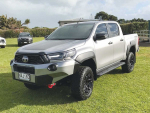
Dairy News was recently reacquainted with a double cab diesel version of the 2WD Hilux. The press vehicle came with a host of extras which included running boards, alloys, a roof rack and rear canopy which are popular with buyers who like to personalise their trucks.
A single cab/chassis starts the range which is in both a 116kW petrol version with 240Nm of torque but we drove a 126kW diesel with 343Nm.
Not the quietest of engines, but it is powerful and flexible enough for most loads. Inside modern farm trucks are getting more car-like in their specifications.
Durable but attractive seat coverings and almost car-like controls are becoming the norm with Bluetooth, cruise control and climate air slowly making its way in to the range in some higher spec models.
With pricing starting at $35,790 and depending on the extras, you will possibly top $50,000 for a top spec 2WD. These are not trying to compete with the Chinese offerings but a Hilux buyer is often a Hilux buyer for life. The price is for a long-term investment banking on reliability and resale value to get the most for their dollar.
Watch out for deals too, Toyota are the masters of the special offer. Contact 0800 TOYOTA.
With Ford holding the reins of the ute market since about 2014, it was always going to be a case of when – not if – Toyota NZ would deliver a model to compete.

Toyota New Zealand has broadened its Hilux range with a new entry level two-wheel drive, the WorkMate, aimed at buyers looking for affordability and Toyota reliability.
Toyota has raised the safety benchmark at grassroots level by introducing its Toyota Safety Sense Package on its hugely popular Hilux.
In its first test in 2015 the eighth generation Toyota Hilux gained a 5-star ANCAP rating.
Toyota has restyled the 14 wide-bodied variants of its 21-model Hilux ute range, as the maker celebrates the iconic workhorse’s 50th anniversary globally.



Three men have been sentenced in District Courts after Ministry for Primary Industries prosecutions over animal welfare, food safety and cattle tracing offences.
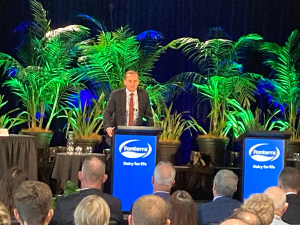
Fonterra’s 2026 financial year was a year of delivery, with record volumes of milk collected, processed and shipped by the co-op.
OPINION: The Government's decision to reinstate agriculture and horticultural science as a standalone subject from Year 11 is the right one.
Dairy farmers, still holding onto their Fonterra shares despite switching milk supply elsewhere or exiting the industry, now face a stricter share sell-down requirement.
Hamilton-based agritech company Aimer Farming has completed a $3 million capital raise to support its next stage of growth, including a beef farming product due to launch in 2027.
When dairy manager Miriam Lauridsen learned the farm, she was joining held weekly health and safety meetings, she initially thought that was “a bit over the top”. Experiencing that culture changed her mind.