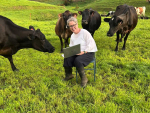
International Day of Rural Women: Two DairyNZ Farmers’ Stories
Today, 15 October, is the International Day of Rural Women, which recognises rural women’s contribution to farming, communities and the environment.
 increase font size
 Andrew Reid.
Almost constant rain will have long term implications for dairy farmers in the North Island, says DairyNZ’s general manager of extension, Andrew Reid.
He says the wet spring has caused a range of problems which will affect the amount of pasture that can be grown and harvested as silage.
Early-season grass is still growing but because the ground has been so wet the cows have trampled the feed, making utilisation poor.
Most dairy farms north of Cook Strait have been affected by the wet spring, Reid says.
“It also meant that because the ground was so wet, contractors had difficulties getting tractors on. So harvesting silage and sowing crops, especially maize, has been delayed two-four weeks and that will have a carry-on effect into the season with later planting dates and less time for crops to respond – a significant issue at this time.”
Reid says in Northland the ground temperature is about two degrees lower than normal, so grass growth has been slower than normal for the time of year.
Two things might ease pressure on some farms, he says. Some dairy farmers have lowered their stocking rate, reducing feed demand from the levels of one year ago. And there is the prospect of a higher farmgate milk price, now set by Fonterra at $6/kgMS.
“The encouraging thing at this time of year is pasture is growing and every windy day is a day of dry and sun to increase the sugar levels in the grass which has been a big problem.”
The late season in the North Island puts a question-mark over whether farmers will be able to harvest sufficient silage to see them through the year. DairyNZ has noticed more farmers are diligent in accurately measuring their pasture quantities by taking time to do farm walks and paying attention to feed budgets.
Some farmers last season skipped herd tests, but Reid is not aware of it happening this season.
He advises farmers applying nitrogen to take care about quantities. The idea of ‘pasture first’, as promoted by DairyNZ, requires farmers to be more diligent in farm management.
Today, 15 October, is the International Day of Rural Women, which recognises rural women’s contribution to farming, communities and the environment.
The first major update to the Dairy Cattle Code of Welfare in more than a decade has been released, marking what DairyNZ describes as an important step in ensuring animal welfare standards continue to evolve alongside scientific evidence and on-farm realities.
Have a plan in place for your cows and staff.
DairyNZ deputy chair Cameron Henderson has been re-appointed unopposed for another term.
OPINION: The stats speak for themselves.


Farmers are being encouraged to rethink how they manage waste on farm with the launch of ruralwastesorted.co.nz, a new website bringing together practical tips, real farmer experiences and resources.

New Zealand Winegrowers (NZW) is celebrating the India-New Zealand Free Trade Agreement (FTA) coming into force today, bringing New Zealand wine improved access to one of the world’s fastest-growing economies.
New Zealand’s red meat sector has welcomed the India-New Zealand Free Trade Agreement taking effect, which removes India’s 33% tariff on New Zealand sheepmeat.
More than 95 per cent of New Zealand’s forestry and wood exports to India can now enter tariff free as the New Zealand-India Free Trade Agreement comes into force today.
Federated Farmers is backing Feilding High School’s call to keep Agriculture and Horticultural Science as a standalone subject in Year 11.
Food and fibre exports have returned a billion- dollar bonus to the country.