Why Now Is the Time to Plan Farm Succession, Findex Says
OPINION: Succession and long-term planning are perennial topics because it is perpetually sidelined on busy farms.
 increase font size
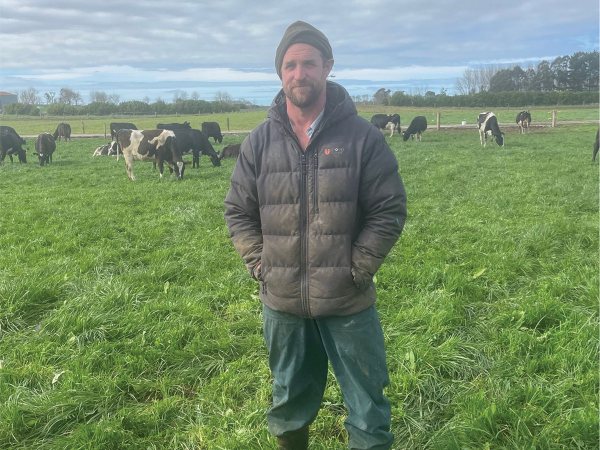 Thomas Werder
Crafting a successful family succession plan is a notoriously hard act to pull off.
Attendees at a recent Smaller Milk and Supply Herds (SMASH) event, near Patea in Taranaki, heard how the Werders have created a plan where everyone in the family benefits.
They also found out how Thomas and Courtney Werder's farming system evolved to meet their goal of low impact farming, with family front and centre.
"It's not about pushing numbers. If we're a 280-cow farm, it's not about pushing to 300 and squeezing about having good cows that produce well," said Thomas.
"The way to describe it is low impact. Low impact on the cows, low impact on staff, low impact on the land. We don't yse massive amounts of nitrogen, we don't run huge stocking rates, and we don't run bare-bones labour set-ups. It's about balance. I like happy cows. I get joy from seeing them content. The kids see cows that aren't run down and stressed.
"I still think there's a lifestyle aspect to dairy farming that's been lost a bit in the industry. That's why low impact is important to me. I enjoy it. I want my staff to enjoy it. I want my kids to see it's enjoyable so they might want to do it one day. Low impact isn't about avoiding stress; it's about having a platform that works. Pushing hard can be profitable - but relaxed and profitable works too.
"When I first came back to the farm, I had big ideas. But the more I farmed, the more I came back to that low impact style," he said.
Open communication is central to the Werders working successfully together as a family. Initially, after their father passed away, they took some time to develop a structure that worked for them.
"In 2008, Dad passed away," said Thomas. "My brother came home and did a year on the farm while I finished university. Then Courtney and I came back. We were workers, then lower-order milkers, 50/50 sharemilkers, leased the farm, and eventually bought it in 2017.
"We also had off-farm income within the dairy industry. Leasing was probably our biggest money spinner. We also moved through equity partnerships with my siblings.
"Mum was still here to start with, but I had a fair bit of freedom in how I farmed. That was exciting - probably frustrating for Mum at times - but she was incredibly open. Her attitude was, 'Go and try it. If it fails, you'll learn from it.' That's something I'll take forward with my own kids. Don't always be the safety net. Let them try. There are things I've done that Mum and Dad might not have thought were great ideas at the time, but they work for our system now.
"Succession planning didn't really exist growing up. After Dad passed, my brother - who had worked at the bank and seen family breakdowns - suggested we start sibling meetings.
"There are six of us. We decided meeting would be siblings only - partners weren't in the room, Mum wasn't either. Nothing was secret; partners could know everything. But the room itself was a safe space.
"In our first meeting we shared out one-year, five-year, and ten-year goals. Over time, things evolved. We'd pool ideas and opportunities. We formed equity partnerships. Shares shifted over time as people moved on. We've all risen together.
"Family support helped us to buy the farm. I've got no shame in saying we couldn't have done it as quickly without them."
Communication and openness are key to the Werders' success as a family, with everyone being heard and supported.
"One of my sayings is: to accept, you've got to understand. Fair isn't always equal. If people understand it, they can accept it.
"The biggest thing was prioritising Mum. All of our family loans are interest-bearing and that interest goes to her. We worked out what she needed to live comfortably - travel to Switzerland, see friends, be with her 18 grandchildren. She doesn't worry about the payout or drought.
"And succession itself wasn't smooth. I brought plans to siblings. They didn't like them. I adjusted. Took them to Mum. She didn't like them. Adjusted again.
"It wasn't clear sailing. There were obstacles. But with communication, patience, and understanding, we worked through it."
Louise Hanlon is an executive member of SMASH.
OPINION: Succession and long-term planning are perennial topics because it is perpetually sidelined on busy farms.

OPINION: One of the privileges of judging the Ballance Farm Environment Awards for more than a decade is the opportunity to spend time on farms and orchards across New Zealand and hear from people constantly looking for ways to improve their businesses.
Federated Farmers president Colin Hurst and his family raised a glass of milk last week to toast the start of a new addition to their farming operation at Makihihi, south of Timaru.
OPINION: She's a bit damp on the East Coast. Hughie can't stop the rain, and the high temps in between weather events has got the flies on the front foot in the animal health stakes.
OPINION: After a very good farming year and a few bucks back in the tin, farmers will be remiss not to consider the next steps in life and what that means for their farming business. Sheep and beef farmers are no exception.


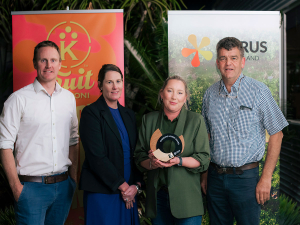
New Zealand's citrus growers were challenged to build their future on the value embedded in their fruit rather than the volume they produce, at Citrus New Zealand's annual gathering in Gisborne on 17 September.
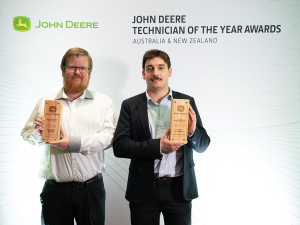
Leading John Deere technicians and apprentices from New Zealand and Australians were recognised at the recent sixth annual JD Technician of the Year Awards, held in Brisbane.
In Dacre, near Invercargill in New Zealand’s South Island, Bruce Dinnington is running a dairy operation unlike any other.
A free online platform aggregating governance vacancies across rural and regional New Zealand has been launched.
Environment Minister Nicola Grigg has announced details of a new rural plastics recycling scheme.
Agricultural drone operators say that a government decision to allow lower-risk drone work without certification won’t lower standards but drive innovation and efficiency.