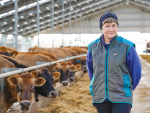
NZ Milk Price Could Hit $10/kgMS as Global Supply Eases
A 'tsunami' of milk from key exporting countries is winding down and this may be good news for New Zealand dairy farmers.
 increase font size
 Report co-author, US-based RaboResearch senior analyst Thomas Bailey.
Could smaller foodservice operators take advantage of the benefits of artificial intelligence (AI)?
A new report from Rabobank suggests exactly that.
In its Foodservice Update for the first quarter of 2024, the bank states AI is becoming more accessible to foodservice operators of all shapes and sizes, with software-as-a-service (SaaS) providers and an increased availability of data are facilitating this shift.
“Data is the essential raw material for AI, but until recently, the foodservice industry lagged behind other sectors in terms of digitalization,” the report reads.
Yet, since 2020, consumers have shifted towards digital channels for both information and transactions.
“Companies that have digitalized their contact with consumers through kiosks and loyalty apps… now possess proprietary data, as do delivery platforms,” it states.
Report co-author, US-based RaboResearch senior analyst Thomas Bailey says current AI applications in foodservice are primarily focused on increasing efficiency, reducing staff workload, optimising marketing strategies, and improving customer experience
“Customer interactions are also being transformed through AI, with highly performing chatbots and telephone assistance software improving the customer experience and operational efficiency,” Bailey says.
“AI software can be used to improve text and images, personalise customer interaction, understand brand perception, and implement more focused pricing strategies,” he says.
However, Bailey is quick to point out that AI is a “work in progress” and “far from perfect”.
“The adoption of AI also carries potential risks, including customer alienation and technology-related issues,” he says.
The report points out that it is a necessity to define the purpose of incorporating AI and its subsequent actions.
A 'tsunami' of milk from key exporting countries is winding down and this may be good news for New Zealand dairy farmers.

Chinese beef trade quotas and a looming suspension of Brazilian beef imports into the European Union are expected to reshape global beef trade flows over the remainder of 2026, with implications for New Zealand exporters, according to Rabobank's Q3 Global Beef Quarterly report.
New Zealand consumers are paying more for beef mince than ever before, with the average retail price now sitting above $24 per kilogram, according to Rabobank.
West Otago dairy farmer Luke Kane has been awarded the 2026 Rabobank Dr John Morris Business Development Prize.
Twenty five secondary school students from around New Zealand recently completed a three day residential programme designed to explore career opportunities across the food and fibre production supply chain.


Ravensdown shareholders have elected Jane Montgomery and Kate Acland to the Ravensdown Board for three-year terms, following a closely contested director election.

Federated Farmers says new legislation replacing the Resource Management Act will cut red tape, unlock investment and help grow New Zealand's export-led economy, after the Planning Bill and Natural Environment Bill passed their third reading in Parliament yesterday.
Leading figures from the major political parties will be questioned on their primary sector policies at the Rural Issues Debate at Mystery Creek Events Centre, Hamilton, on 30 September.
OPINION: Have a plan in place now!
Beef + Lamb New Zealand (B+LNZ) says it welcomes the passage of the Natural Environment Bill and Planning Bill, calling the bills a positive step for sheep and beef farmers.
A spate of southerly winds bringing cold temperatures has presented challenges for Taranaki dairy farmers.