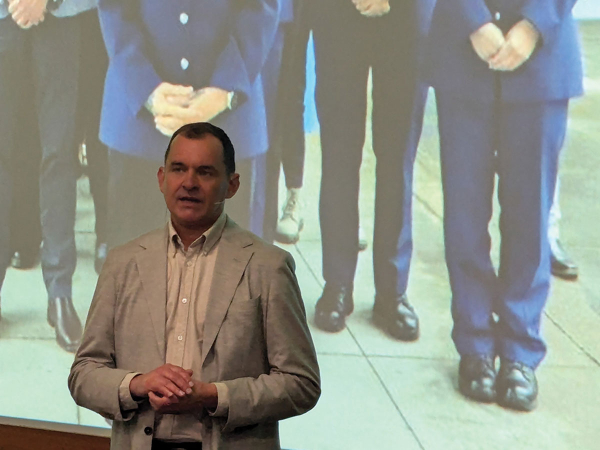
New Zealand farmers have been told they all have amazing people on their farms and have been urged to be “that one person” that can make a huge difference to those going through tough times.
From being a young West Auckland tearaway on the wrong side of the law, Zion Armstrong turned his life around, competed as a hurdler for New Zealand then went on to lead Adidas North America to record-breaking commercial success. He was a keynote speaker at Dairy NZ’s recent South Island Dairy Event (SIDE) at Lincoln University.
Introducing himself at SIDE, Armstrong said that at the age of 14, he was chased on foot by police through West Auckland after dumping a stolen motorbike, and managed to outrun them, although finally caught by police dogs while hiding under a house – and still has “quite a few scars” to remind him.
Then a few weeks later an unmarked police car pulled up to the family house and West Auckland District Commander Ross Dallow stepped out and knocked on the door.
Armstrong said that despite there being nine other kids in the house to choose from, “Mum looked straight at me and said, ‘What have you done now?’”
“And [Dallow] says, ‘It’s not what he’s done. It’s what we think he can do. I’m the local track and field coach. And the guys he ran away from that night, one of them was the fastest man in the country’.
“So, he bundled me into his car, and I went down to the local track and field club, and that was the start of, not only a friendship, but him becoming my father and of course, correcting my life.”
Armstrong’s message to farmers was that they might get young people on farm who are “a little bit naughty” but could be an unpolished gem whose lives can be changed with time and guidance and being there for them.
“All of a sudden I had this person who put their arms around me and showed me the right way, and I’m sure you’ll have some of those kids on your farm at some stage.”
Under Dallow’s guidance, Armstrong went on to became a champion hurdler, represented New Zealand at the 1998 Commonwealth Games, and only narrowly missed selection for the 2000 Olympics. With a Fijian father, he was invited to run for Fiji but declined because he had been so set on wearing the New Zealand black singlet.
“Don’t decline opportunities to run in the Olympics. I wish I was standing up here today saying ‘bula vinaka’. My pride got in the way.”
After that he hung up his spikes. Meanwhile, however, he had been working for Adidas since he was 16, initially just packing and unpacking shoes, and had worked his way up to the New Zealand leadership team.
Then came what he called another “sliding door” moment, when he was invited to the Adidas headquarters in Germany to interview for a job running a business unit. What followed was a career heading various business units, before eventually becoming president of Adidas North America and leading it to overtake arch-rival Nike while posting record profitability.
Doing the Right Thing
Armstrong outlined his time as the head of Adidas North America, emphasising a philosophy of doing what’s right and putting people first.
The German head office had never been able to align its European values with American sports culture until he persuaded them to send half the product development team to the American base in Oregon “so we could actually sit in front of the customer, listen and react. And that was the start of us fixing the company in the United States”.
Along the way he led Adidas to be the first to produce shoes specifically tailored to the unique needs of Down syndrome athletes, and signed to sponsor Caribbean-born Montreal hockey player PK Subban not because he was a champion athlete but because he had donated his entire $10 million annual salary to a children’s hospital.
Then, discovering that Adidas was paying athlete Lindsey Horan a $15,000 bonus for being named national women’s soccer league player of the year while the equivalent male athlete would get $150,000, he tore up her contract on stage in front of 3000 people at a conference and said she would get the same.
He said he did not realise he was setting a legal precedent “but it was the right thing to do”.
Armstrong was also proud of the way he handled the Covid pandemic, closing the retail stores to protect staff, even though head office initially said not to.
However, the travel and quarantine restrictions of Covid took a toll, with Armstrong still in the US and family still in New Zealand. Shortly afterwards, he resigned from Adidas and returned to New Zealand. He is now CEO of the Jamie Kay kids’ clothing group was recently named as a wing patron of the New Zealand police.