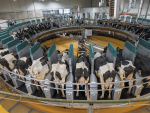
Robotic Rotary Milking: Inside a $6M Investment Paying Off Faster Than Expected
The Dairy ProQ robotic rotary, the first of its kind in the Southern Hemisphere, has proven to be an impressive addition for Victorian farmers Paul and Marsha Smith.
 increase font size
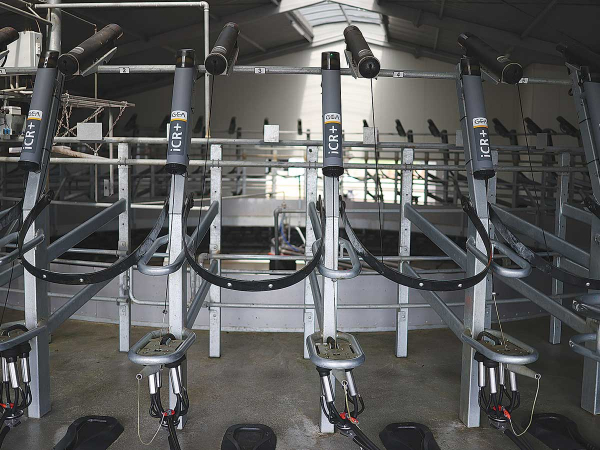 GEA says its new iCR+ cluster removers are a game changer inside the milking shed.
GEA says its new iCR+ cluster removers are a game changer inside the milking shed.
The company says cluster removers deliver improved cupping efficiency, better udder health, time savings and reduced labour.
It gives the example of Waikato farmer Dries Verrycken, who milks 500 cows.
Verrycken noted a saving of 1-2 seconds/cupping with the iCR+, which adds up to 16 minutes in total cupping time at just one milking.
GEA New Zealand product manager Ben Morris says this means Verrycken could increase throughput by another 100 cows and still finish milking at the same time.
“Or be home 30 minutes earlier every day.”
Featuring unique EasyStart lift or pull vacuum activation, iCR+ helps to simplify and minimise workload, saving 1-2 seconds/cow at cups on alone.
It is designed to fit any parlour type or any make of milking machine, so can be retrofitted or added with a new parlour build.
Morris says the automated EasyStart is intended to support efficient cupping techniques and milking efficiency.
“With lift or pull vacuum activation, the milker has control over what works best for them. And with no need to push a button to activate the vacuum, they will save 1-2 seconds in cupping each cow.”
Morris notes that the iCR+ is already in use on local farms and the labour efficiency is evident.
“The iCR+ is a simple matter of lift or pull, cup and milk. Partnered with GEA’s market-leading Classic 300 E clusters, we believe we have the best solution for achieving the ideal cupping time of 4 seconds,” he says.
A cost-effective option with high-tech functionality, iCR+ can be set to fixed point, timed or milk flow take-off, ensuring over milking does not happen.
Clearly visible LED lamps highlight the milking status in each bail, quickly alerting staff of any problems during the milking process. Protecting udder health was also a key consideration in the iCR+ design. When milking is finished, the cluster is vented and the vacuum shut-off before retraction to ensure gentle removal from the teats.
Automation options create even better milking efficiency. In rotary parlours, drop-down activation means clusters will automatically drop out of the way below the bridge when milking is complete.
“iCRS retention straps can be installed to retain cows on the platform in the case of a milking alert. And iPUD automatic teat spray units are an excellent add-on for consistent post-milk teat spraying on every cow.”
For herringbone parlours, the iCR+ milking alert feature sees the cluster retracted and then lowered to hang in the pit area, so it is visible to the operator. The iNTELSPRAY2 walk over teat sprayer can be added too.
The Dairy ProQ robotic rotary, the first of its kind in the Southern Hemisphere, has proven to be an impressive addition for Victorian farmers Paul and Marsha Smith.
GEA says that its latest walkover teat sprayer is helping farmers save time and boost udder health.
New Zealand farmers get their first opportunity to experience the future of pasture-based dairy automation in action this week at the National Fieldays.
Milking technology provider GEA Farm Technologies is introducing its first automatic milking system (AMS) in New Zealand.
In a groundbreaking move for dairy farming in New Zealand, Craig Copland has become the first farmer in the country to use GEA’s Manure Decanter system, traditionally used in wastewater and wineries, to enhance environmental sustainability on his Canterbury farm.



LIC shareholders have elected a new North Island representative to the co-operative's Board, along with five representatives to its Shareholder Reference Group (SRG), following the company's Annual Meeting held in Invercargill.
Farmers across parts of Southland and South Otago are continuing to deal with difficult conditions after a prolonged run of wet weather, with pressure building around feed supply, stock management, pasture damage, farm infrastructure and everyday workloads.
Federated Farmers says it welcomes Labour's commitment to reviewing the Sharemilking Agreements Act, calling on other major parties to do the same.
For Canterbury dairy farmers Sian Meijer and Rick Wobben, wearable technology has become one of their most valuable on-farm tools - helping manage 1850 cows across an expansive, high-performing dairy operation while improving efficiency, mating outcomes and day-to-day decision making.
Fonterra has unveiled its annual results for the 2026 financial year, posting $27 billion in revenue and close to $20 billion returned to New Zealand farmer owners and unit holders.
The first major update to the Dairy Cattle Code of Welfare in more than a decade has been released, marking what DairyNZ describes as an important step in ensuring animal welfare standards continue to evolve alongside scientific evidence and on-farm realities.