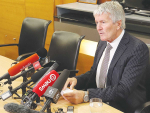
Leaving on a jet plane - again!
Damien O'Connor is planning to head back to Europe again shortly to breathe oxygen into the free trade agreements that New Zealand is negotiating separately with the UK and the EU.
 increase font size
 John Droppert
In just under two months’ time, the world’s largest milk producer will see one of its biggest regulatory changes in three decades.
As an aggregate, the European Union produces around 150 billion litres of milk per year, and commands almost a third of global dairy exports (in liquid milk equivalent terms).
Since 1984, milk production has been contained by a quota system that was designed to rein in the ballooning cost of the Common Agricultural Policy (CAP).
From the end of March this year, quotas will disappear, with much speculation around the impact on European milk production, and consequently global dairy markets.
In the decades following its formation, the then-European Economic Community (EEC – now European Union – EU) had an entrenched price support framework based around intervention buying, combined with export subsidies as a means of disposing of the surplus product.
The problem was that in managing the internal market so well, the EEC fostered rapid growth in milk deliveries, which by the late 1970s and early 1980s grew beyond what the framework (and budget) was designed to handle.
Like most market support mechanisms, the quota system is a complex beast.
However, broadly speaking, member states of the EU are each assigned a ‘reference volume’ based on milk fat content, which is then broken down to quota volumes for individual producers.
The quota year runs from April to March of the following year.
If milk deliveries in a member state exceed national quota, those farmers who have overrun are liable for a punitive levy (the superlevy).
In addition to milk deliveries to processors, a much smaller scale set of quota is allocated for milk sales direct from farms.
After an initial four year period, the quota system was renewed, with reference volumes reduced by 2% in 1988 and 1% in 1989.
The system saw few changes in the 1990s (mainly formalisation quota transfers between producers within a member state) and modest increases to quota volumes were granted in the early 2000s.
By 2006, political support had waned as the CAP more broadly was adjusted towards better market orientation, and plans were being developed to remove the quota system.
The CAP ‘Health Check’ in 2009 confirmed the end of quotas in 2015, laying out an annual increase in volumes of 2% in 2008/09, followed by 1% annually between 2009/10 and 2013/14 to provide a ‘soft landing’.
The final year (2014/15) holds quotas at the 2013/14 level.
The European Commission maintains that the considerable expansion of recent years suggests there will be no ‘explosion’ in production after March 31.
This is supported by the deterioration of farmgate margins over the past few months (the result of a period of global dairy oversupply, exacerbated by the Russian import ban) which will make immediate expansion less appealing, and more difficult to finance.
Strong milk production growth over the last 12 months suggests many farmers will also be dealing with a particularly heavy superlevy burden this season.
With milk prices deteriorating, the penalty of €28/100 kg will possibly exceed revenue (around €30/100kg or A$5.90/kg MS and falling) for some over-quota milk, leaving no income for that milk after the fine is paid.
The significant influence of volatile market and seasonal conditions will continue to drive the year-to-year ebbs and flows of milk output.
Nevertheless, member states with aggressive post-quota expansion intentions (such as Germany, the Netherlands, Ireland and Denmark) are likely to see significant medium term growth – with patterns of plant investment to date weighted towards milk powders.
Much work attempting to quantify the net impact on market balance associated with the removal of quotas has been done, but in essence, nobody knows for certain.
There remains an ongoing push to ‘manage’ the market in the absence of quotas – with plenty of political support amongst the European Parliament and sections of the farming community.
What does appear guaranteed is that the tension between those advocating a protectionist approach and those seeking to give market forces more influence will remain a feature of European politics.
• John Droppert is Industry Analyst with Dairy Australia.
Damien O'Connor is planning to head back to Europe again shortly to breathe oxygen into the free trade agreements that New Zealand is negotiating separately with the UK and the EU.

A hint from recent trade talks suggests that New Zealand may not get everything it wants in its free trade negotiations with the European Union and Britain.
A jump in the value and volume of New Zealand’s sheepmeat exports to Europe and the UK shows why preserving WTO tariff-rate quotas is so important, claims the Meat Industry Association (MIA).
Britain's decision to break its deal with the EU over Brexit is creating uncertainty for NZ dairy exporters, according to Malcolm Bailey — chair of the Dairy Companies Association of NZ (DCANZ).
Trade experts are warning that time is running out to secure the future of New Zealand red meat exports to the European Union.


Federated Farmers has welcomed new rural policies released by ACT, saying they align closely with its own election priorities.

Rural Contractors NZ says proposed changes to land transport rules for agricultural vehicles are a welcome response by the Government to out of date regulations which have seen members hit with huge fines.
Alliance is calling for final applications for its 2027 Graduate Programme, with applications closing on Sunday 25 October.
Decades piloting planes has ensured vet and farmer David Hayes is focused on safety. So, after a serious accident while welding on farm, he is sharing his experience so others can learn from it.
Canterbury milk processor, Synlait Milk has confirmed Leon Fung as its chief executive officer.
OPINION: Making it easier to collect rainwater and use it to grow crops and livestock is a no brainer.