DairyNZ chair wants cross-party deal
New DairyNZ chair Tracy Brown says bipartisan agreement among political parties on emissions pricing and freshwater regulations would greatly help farmers.
 increase font size
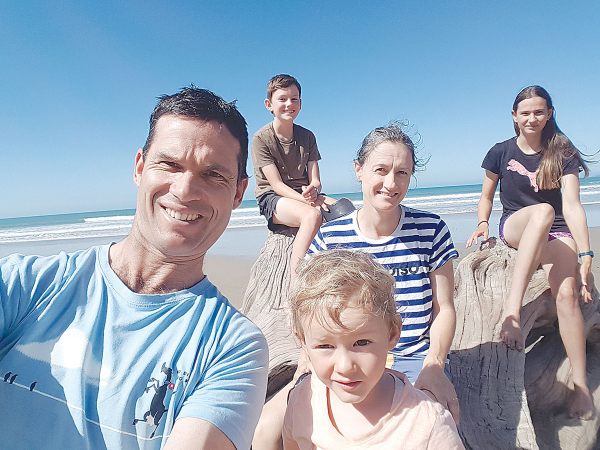 South Otago sheep and beef farmers Hamish and Amy Bielski and family.
OPINION: Using efficiency of production as the driver in the proposed methane tax equation by HWEN is causing us, as farmers, much disillusionment.
Regardless of farm type, this method will penalise any system that has slower or lower overall production. This is the case even if it uses less 'undesirable' inputs and naturally matches the land's capability.
It is hard to marry up the hypocrisy and inequality in this considering the Government's much politicised and haloed talk around regenerative agriculture (RA). One of the key concepts of RA is to follow the natural grass growth curve, using more solar energy and less fossil fuel to produce food.
Fundamentally. we have three ways to harvest food: livestock, manual labour or diesel. NZ's design is such that it effectively grows pasture and uses livestock as harvesters and converters to protein. It follows that the closer we as farmers can manage our livestock to the pasture growth curve, the less diesel energy we use. However, these systems - whether sheep, beef or dairy - are less 'efficient' per unit of methane produced, so will pay a higher tax in HWEN relative to production.
So, on one hand the Government recently committed $26 million to research regenerative agriculture in NZ, and on the other they seek to penalise those farms that have already applied and are farming under many of these principles.
Can you see the irony?
Do HWEN and politiciand want improved ecosystems through lower intensity farming, which uses less fossil fuel while promoting long term biodiversity and sustainable land and water management (i.e., "fit for a better world") or not?
There is no consideration in the proposed tax equation of starting natural capital, total amount or type of input used - particularly the energy (fuel) requirements on each farm.
For example, an intensive barn-based wintering system using large amounts of synthetic fertiliser, supplements and diesel will have a lower emissions tax burden as a percentage of their bottom line than a largely all-grass wintered, low-N usage dairy farm. This is simply because it produces more product, irrespective of the cost of the barn or the amount and type of inputs, over and above the natural capability of the land.
The second farm: a dairy unit that doesn't use N fertiliser, winters its animals on saved pasture supplemented with bales (sometimes made and fed out in the same paddock to preserve its natural energy cycle), stocked to a level that matches the natural pasture production curve and prevents environmental damage if carefully managed (high covers on a large area, no bare soil). Yes, this scenario might produce less, but what value is apportioned to the overall type and amount of inputs required? Nothing but a penalty!
Sheep and beef systems face the same fate as the lower intensity dairy farm. The typically lesser quality land in terms of potential pasture production than a dairy farm is not accounted for. The cost of getting increased production is also a lot higher for a sheep farm relative to a dairy farm due simply to location and terrain (to add more synthetic fertiliser might require an airplane/helicopter versus a spreader on the back of a tractor).
Another example is the beef cow; she produces a calf and unmonitored milk supply from the “rough” pasture on hill country that no other class of stock will eat.
How can you compare these systems using just methane produced/kg product, when the inputs and the natural capabilities of the resources being used to produce the product are vastly different?
HWEN is fast losing creditability and integrity for this reason and farmers might be increasingly comfortable saying ‘NO’.
Amy and Hamish Bielski are South Otago sheep and beef farmers
New DairyNZ chair Tracy Brown says bipartisan agreement among political parties on emissions pricing and freshwater regulations would greatly help farmers.

First up to the podium at the recent Tractor and Machinery Association (TAMA) Conference in Wellington, Minster for Agriculture, Todd McClay, reflected on a difficult 12 months, but hinted at signs that things were turning the corner, saying “when ag does well, New Zealand does well”.
A horror story - that’s how Federated Farmers describes new research looking at forestry conversions’ impact on water quality.
OPINION: When Groundswell showed up in the 'advocacy hub' at Fieldays alongside the same groups that brought you He Waka Eke Noa, the Hound feared the ginger group had been brought into the woke fold and given the old rubber ring.
Farmers with experience and breeding knowledge are deeply concerned about the pressure to breed for low methane sheep traits and its effects on other important traits they have been pursuing over the last 100 years.



Wool Impact and ASB have signed a new partnership with the bank set to provide financial backing to support the revitalisation of New Zealand's strong wool industry.

OPINION: Farmers have been clear: it is getting harder, not easier, to find and keep good people.
Last week marked New Zealand Sign Language Week and a South Canterbury tanker operator is sharing what it's like to be deaf in a busy Fonterra depot.
As fuel and fertiliser prices rise and with uncertainty in the future, farmers are being urged to go over their budgets with a fine-tooth comb.
Federated Farmers says reforms of local government announced last week will be music to farmers' ears.
Hinehou Timutimu, the 2026 Fonterra Dairy Woman of the Year, says she feels privileged to have won the award.