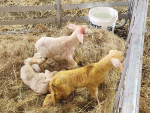
Beef + Lamb NZ's Lambing Kit Checklist for a Tough Season
With lambing underway in many regions, Beef + Lamb New Zealand is encouraging farmers to put together a wellequipped lambing kit to help minimise lamb losses, particularly in bad weather.
 increase font size
 Australian livestock consultant San Jolly says maximising ewe survivability and profitability are underpinned by four key profit drivers.
Managing ewes for maximum survival and profitability is underpinned by four key profit drivers, says Australian livestock consultant San Jolly.
Jolly, of Productive Nutrition, recently spoke about those profit drivers to producers at ‘Pastoral Profit’ workshops, held jointly by Meat and Livestock Australia and Australian Wool Innovation, in NSW and Queensland.
He reminded producers that measuring and monitoring are vital to guide management, and productivity improvements lead to profits only by reassessing cost of production annually and running gross margin budgets on feeding strategies.
Jolly says the first step to assessing the nutritional requirements of ewes is to weigh them, “to provide a baseline to monitor weight gain/loss for early intervention and management”.
Based on ewe weights and fertility (measured by pregnancy scanning), producers can determine their DSE (dry sheep equivalent) and estimate feed demand.
Jolly’s tips are: buy scales to monitor weight gain or loss for targeted management, assess readiness for joining, and ensure the dosage of drenches is correct for the weight of the sheep.
The second step concerns feed quality. “The best time to test feed quality is before you need it – before lambing and again before weaning”.
Feed test results can guide decisions on the cost-effectiveness of supplementary feeding if pasture protein levels are low, and provide information about whether pasture condition or other factors (such as genetics) are influencing weight gains.
Her tip is that feed quality cannot be accurately assessed visually; consultants can advise on how to take accurate samples and where to send them for laboratory testing.
The third step is stocking rates. There are several times of year and methods to assess stocking rates (based on kgDM/ha) including when there is a feed wedge before sheep go into a paddock, or during winter when pasture is growing.
Fourth is genetic potential. Genetics underpin the potential for fleece weight, fertility, growth rate and lamb survival.
Each enterprise will have different priorities so it is valuable to have formal breeding objectives to focus ram selection and culling decisions. Broad rules of thumb for optimising genetic profit drivers include:
Identify the constraints to your production system (such as environment or predation) and focus on areas within in your control.
Weigh lambs at weaning to see if genetics are translating to enhanced growth rates.
Match rams to your target market: for example, if producing store lambs then prioritise ASBVs for high weaning weights.
Joining presents another opportunity for producers to increase ewe productivity. With many pastoral producers preparing to wean now, Jolly says good pre-joining activities include:
Draft ewes into light/heavy or fat/thin mobs using the most efficient and appropriate method for your business (eID/auto drafting based on weight or condition scoring).
Start managing the light/thin ewes with preferential allocation of feed to bring them up to the target joining weight
Draft out dry ewes so they do not re-enter the breeding programme.
Now is the time to start planning for weaning nutrition by taking feed quality tests and mineral deficiency tests to guide supplementation decisions, says Jolly.
With lambing underway in many regions, Beef + Lamb New Zealand is encouraging farmers to put together a wellequipped lambing kit to help minimise lamb losses, particularly in bad weather.

New Zealand wool is reaching new heights as air filtration companies move away from synthetic products to biodegradable alternatives.
Will a stronger, more coordinated voice help rebuild confidence and improve returns in the wool sector?
OPINION: Confidence in the wool sector is rebounding as prices hit levels not seen in more than 15 years.
The recently signed free trade agreement with India is an invitation to strengthen relationships between the New Zealand and Indian strong wool industries, says Wool Impact chief executive Andy Caughey.
Farms across the upper North Island are trialling different pasture mixes as part of a research programme that aims to build greater resilience into farming systems.
Election years are always a concerning time for farmers, according to DairyNZ chair Tracy Brown.
The Ballance Farm Environment Awards are coming to the West Coast of the South Island.
Most dairy regions around the country have had a pretty good season so far says Tracy Brown.
Rural leader Mark Hooper has been appointed as an independent director to the NZPork board, bringing extensive farming, governance and advocacy experience to the role.