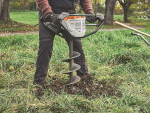
Stihl Launches BT140, Its First Battery-Powered Auger
With battery tools becoming more widespread and more importantly, productive and reliable, it was only time before we saw augers or post-hole borers.
 increase font size
 Claas has integrated the Terranimo application into its CEMOS control system for tractors.
German manufacturer Claas has integrated the Terranimo application into its CEMOS control system for tractors.
While CEMOS is still the only selflearning, interactive driver assistance and process optimization system, the Terranimo application will enable the tractor-implement setting to be even more focused on soil protection.
Terranimo is a simulation model. It was developed by the Bern University of Applied Sciences (BFH-HAFL) in cooperation with the Agroscope Reckenholz Research Institute, Aarhus University in Denmark and the Swedish University of Agricultural Sciences (SLU) and calculates and visualizes the risk of compaction. The model’s algorithms are based, among other things, on decades of accumulated best expertise.
In CEMOS for tractors, these are combined with the other information – such as soil type and condition, working depth, field condition (uncultivated, shallowly tilled or deep tilled), attachment, tyre type and ballasting.
Based on this combined information and the technical data calculated by CEMOS, such as static or dynamic axle loads, Terranimo calculates the compaction risks for three soil layers. Based on the assessment, CEMOS can then provide the driver with further recommendations for ballasting and optimizing the tire pressure to create the least damage to the soil structure.
If any changes are made to the tractor or implement settings, any changes in the risk of compaction flows directly into the current risk assessment of the Terranimo function. As a result, the driver will receive direct feedback on the effect that changing the settings will have on the soil structure.
With battery tools becoming more widespread and more importantly, productive and reliable, it was only time before we saw augers or post-hole borers.
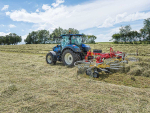
Austrian manufacturer Pottinger has released details of a new compact, linkage-mounted compact twin rotor rake, without a chassis, that is said to deliver impressive manoeuvrability.
The new Lemken Saphir XMR mechanical seed drill has been introduced as the successor to the proven Saphir 10m, with the manufacturer claiming new standards for precision, ease of use and area coverage.
Krone's XDisc 710 direct-cut header can now be used by John Deere and New Holland forage harvesters, as well as the Krone Big X it was originally designed for.
Fifty Eight years ago, on the 16th of August 1968, August Claas, the founder of the harvesting company and father of Helmut Claas, personally presented a Claas Senator combine harvester to Scottish farmer John Steven.


Farmgate lamb prices are down by 8%, beef cattle by 4.5% and farm expenditure up by 4.2%.
Kiwifruit growers are watchful but remain optimistic as concerns around the potential effects of the El Niño weather pattern this season.
Almond hulls sourced from Australian orchards may have the potential to help New Zealand cows reduce emissions, boost milk yield and lower input costs.
Striking a balance between meeting the needs of industry to speed up approval time for products but on the other hand ensuring that risks are properly assessed.
Surprised, humbled and quite thrilled. That’s the reaction of James Allen, one of the founding partners and now chief executive of AgFirst, on being made a life member of the Institute of Rural Professionals.